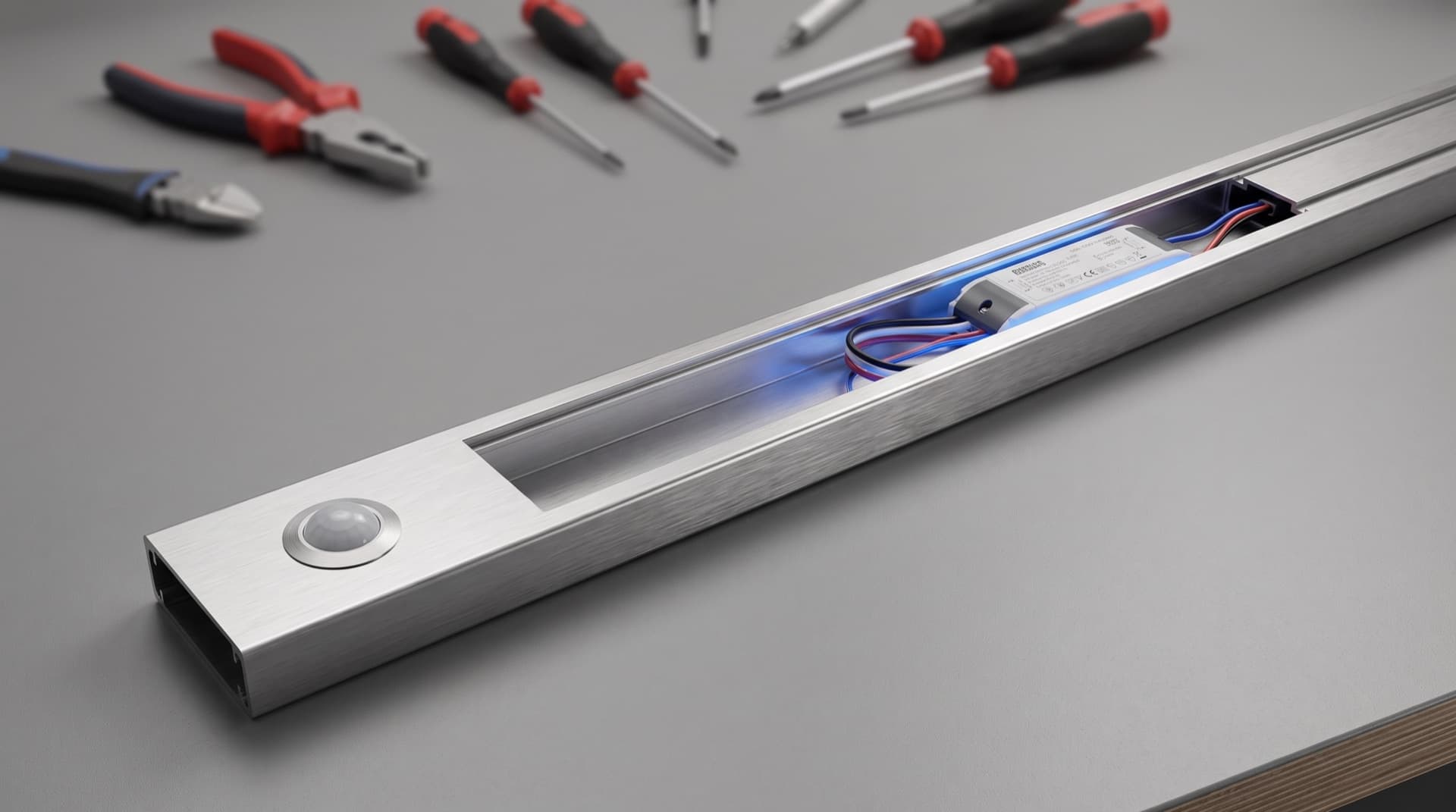
Build Your Own Smart Luminaire with Modular Bluetooth Components
When upgrading an existing luminaire — or designing a new one — to be smart, meaning both wirelessly connected and equipped with sensors, there is a stack of factors to weigh for every fixture:
- driver type and power output
- driver dimensions (it has to fit the housing)
- IP protection rating
- radio reception — whether the signal can get in and out of an often-metal housing
- whether a motion sensor and/or a light (lux) sensor is needed
- dimmability and colour control (tunable white)
The driver alone is a project. A traditional on/off luminaire asks very little of its driver; a dimmable one asks a lot — a poorly designed dimmable driver hums audibly whenever brightness sits between 0 and 100 %, and PWM frequency decides whether the light flickers on camera. Picking the right driver is hard enough on its own. Combine it with the factors above and finding one matching set of hardware becomes genuinely complicated.
Two things make a luminaire smart
It means two things: the fixtures connect to each other, and they handle the everyday adjustments themselves.
Connectivity starts with Bluetooth. Each fixture joins a local MESHLE Bluetooth Mesh and talks directly to its neighbours, with no wiring back to a controller. One network handles up to 255 fixtures, and you can link several together through the MESHLE Edge server to run up to 20,000 across a site. It all works offline: no Wi-Fi, no cloud, no hub. A Gateway is optional, only if you want remote access or a BMS connection.
Automation is the second half. You set it up once, and each fixture runs it locally:
- Presence-aware Swarm — light follows movement across a group; the area around a person stays bright while everything else idles.
- Daylight regulation — a light sensor reads ambient lux, so fixtures only switch on below a darkness threshold, or dim to top up daylight instead of overriding it.
- Tunable white and Human Centric Lighting — colour temperature shifts warm-to-cool through the day for circadian comfort.
- Scheduling — time- and sun-based control stored on the devices, so cycles run with no app open and no internet.
The antenna, the sensor, and the driver
The system is built from three kinds of part: a Bluetooth antenna, a PIR sensor, and a driver. The antenna and the sensor both speak UART and both mount in the same 20 mm hole, which is what makes them interchangeable. The driver carries an MCU but no radio of its own — it gets its intelligence from whatever you plug into it.
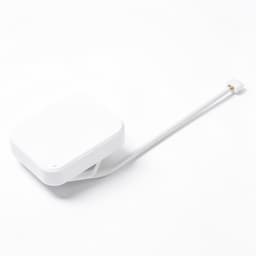
CUPOWER SKY Antenna
The CUPOWER SKY Antenna is a Bluetooth module with a strong antenna and a UART output, running MESHLE Bluetooth Mesh firmware. It mounts in a standard 20 mm hole in the fixture's metal surface so the antenna sits on the metal skin for range, while the driver stays hidden inside the housing. It comes in black, white, and gray to match the fixture, and works with every CUPOWER SKY driver.
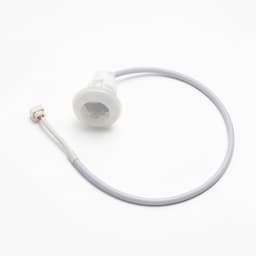
SHARKWARD Bluetooth Sensor
The SHARKWARD Bluetooth Sensor is an IP66-rated PIR occupancy sensor with the same 20 mm hole mount and the same UART output as the antenna. Because it shares the interface, it works with any CUPOWER SKY driver as well as the MESHLE 0-10V driver. Its IP66 rating means it is suited to outdoor and washdown environments, not just clean indoor ceilings.
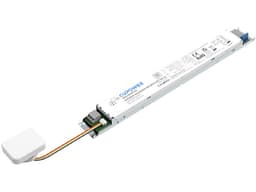
CUPOWER SKY drivers and the MESHLE 0-10V driver
The CUPOWER SKY drivers are constant-current drivers with an MCU but no Bluetooth — they take the antenna or sensor over a UART cable, which is how the radio becomes a swappable part rather than a fixed board. The family includes linear and compact form factors and tunable-white options; the confirmed linear model 166800, for example, runs 100–900 mA out in a 405 × 29.5 × 16 mm body with tunable-white output. MESHLE's own 0-10V driver (4-channel) also accepts both the SKY antenna and the SHARKWARD sensor over UART, so the same modular parts span CUPOWER drivers and MESHLE's own.
How the parts fit together
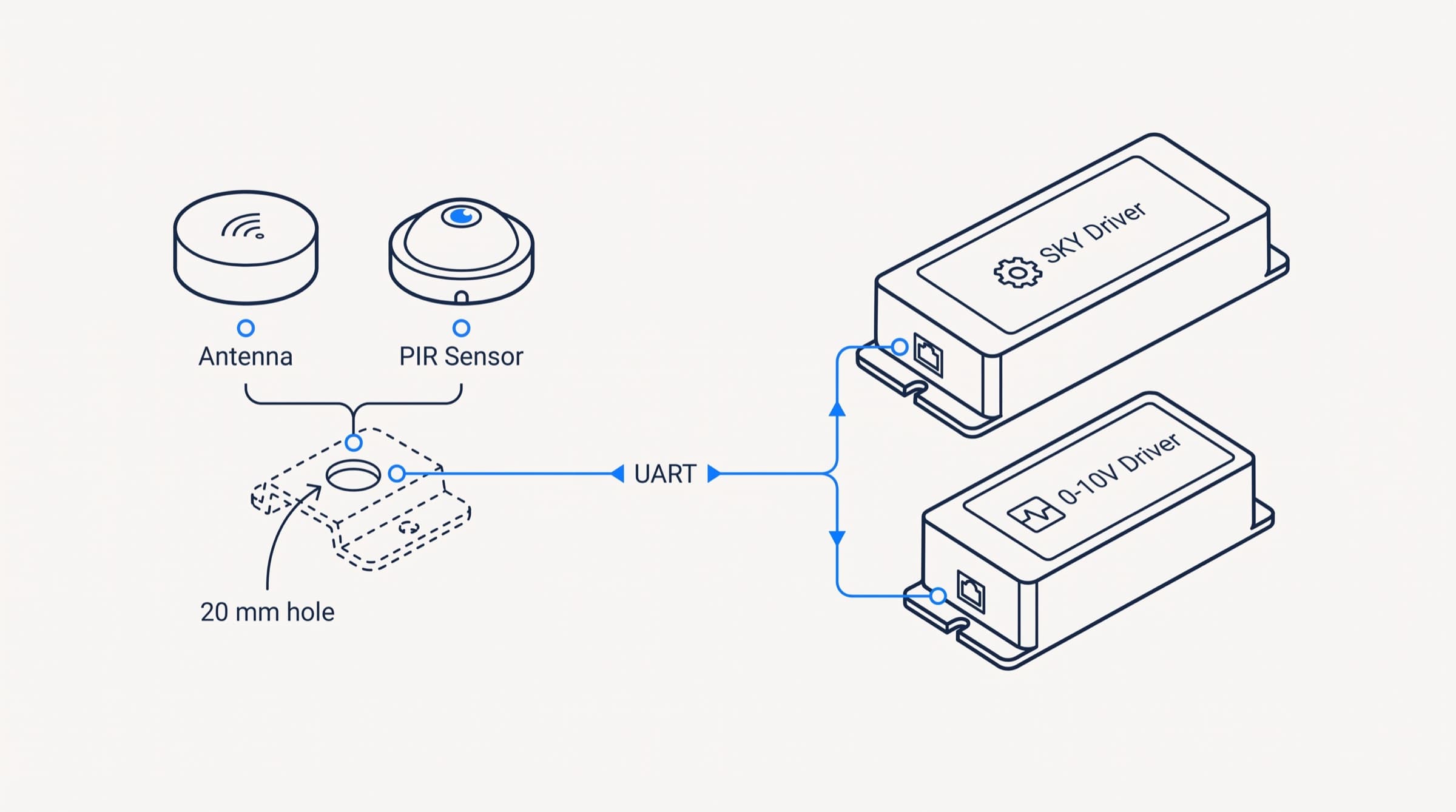
Because the antenna and the sensor share a UART interface and a 20 mm hole, you choose per fixture what each one needs. Some luminaires get only the antenna — they become Bluetooth-controllable and join the mesh, but rely on neighbours for presence. Some get only the sensor — they contribute occupancy data to the group. Many get both, becoming fully self-aware nodes that sense and respond. The decision is made at install time, not locked into a board design.
That single, interchangeable kit is what makes the system universally versatile. The same parts go into flat panels, pole and street lights, high-bays, and downlights, and the same parts work across CUPOWER SKY drivers and the MESHLE 0-10V driver. One stocked set of components covers a whole catalogue of fixtures — and every fixture it touches lands on the MESHLE Bluetooth Mesh, offline-first, ready for Swarm, tunable white, and daylight harvesting.
Watch the SKY antenna assemble onto a CUPOWER SKY linear driver — the UART connection and shared 20 mm mount are exactly what make the radio a swappable part rather than a fixed board.
CUPOWER SKY Linear Driver Installation with SKY Antenna | Powered by MESHLE — assembling the modular antenna onto the driver over UART.
What the lights can do once they are connected
Swarm — presence-aware light that follows movement
Fit sensors and antennas across a group of fixtures and you get MESHLE Swarm: light that is aware of where movement is happening and reacts together. The closest lights go to their configured brightness, lights further out dim in a gradient set by each sensor's inner and outer radius, and the rest stay at idle. When movement moves, the bright zone moves with it. For the full picture of how it behaves and how it is set up, read our complete guide to swarm lighting.
A sensor's inner radius holds full brightness while the outer radius fades to idle in a gradient — drag to see lights respond.
Tunable white and Human Centric Lighting
With a tunable-white driver, the same modular parts deliver warm-to-cool white control and Human Centric Lighting — colour temperature that shifts through the day for circadian comfort. HCL runs on top of Swarm, so one layer decides how bright and the other decides what colour temperature. See the tunable white (CCT) interface for how the white-light side works in the MESHLE App.
Daylight harvesting
Add a light sensor to the group and the system reads ambient lux. You can use that to switch fixtures on only once daylight drops below a threshold, or to regulate brightness directly so artificial output only tops up the natural light already in the room. Settings can be mixed within one group — fixtures near a window regulate against daylight while those deeper inside simply respond to presence.
Where it works best
Office and panel lighting

Flat panels and linear fixtures are the most common candidates: a SKY antenna in a corner of the metal frame makes a panel mesh-controllable, and a SHARKWARD sensor makes it presence-aware. Across an open-plan floor, the panels run Swarm so light follows people through the space, while manual overrides on desk and floor lamps stay respected. Add a tunable-white driver and the same panels run HCL for circadian comfort through the working day. Walk through it in the office 3D showroom.
Street, pole and pathway lighting
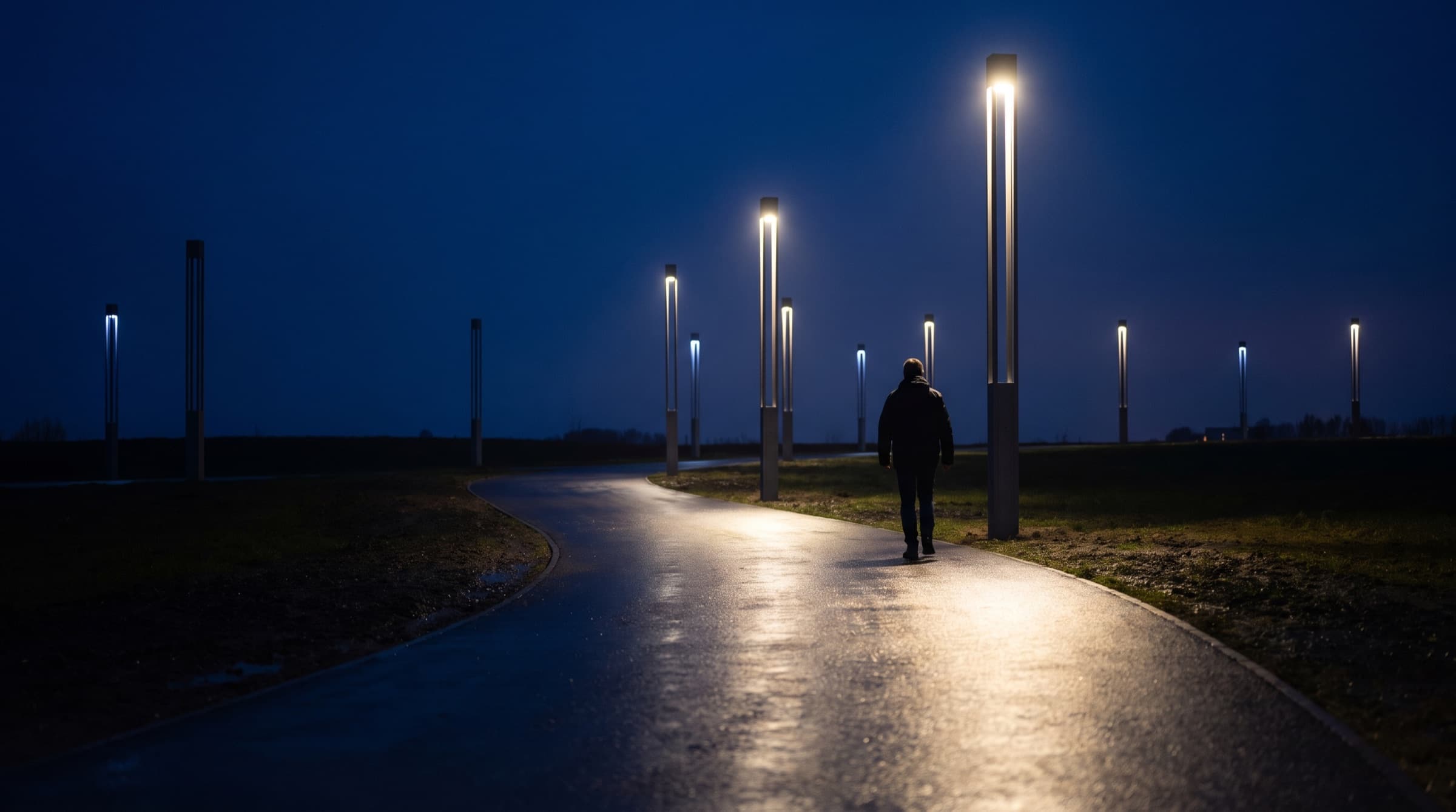
On pole and pathway luminaires, the antenna mounts on the metal skin for the range that outdoor distances demand, and the IP66 SHARKWARD sensor handles the weather. A run of pole lights becomes a Swarm group where a bright zone travels ahead of a pedestrian, cyclist, or vehicle and fades behind them, while the rest of the path sits at an idle baseline. Daylight harvesting keeps the lights dark until dusk. See it run in the evening-park 3D showroom.
Warehouse, parking and industrial halls

Large interiors are where always-on lighting wastes the most. Drop the modular parts into high-bays and battens, group them, and Swarm lights only the aisle or bay where a forklift, picker, or vehicle is actually moving. The rest of the hall holds an idle level that still satisfies safety and movement requirements. Because the antenna is a swappable UART part, the same fixture family scales from one aisle to a whole campus. Explore the warehouse 3D showroom.
Stairwells and corridors
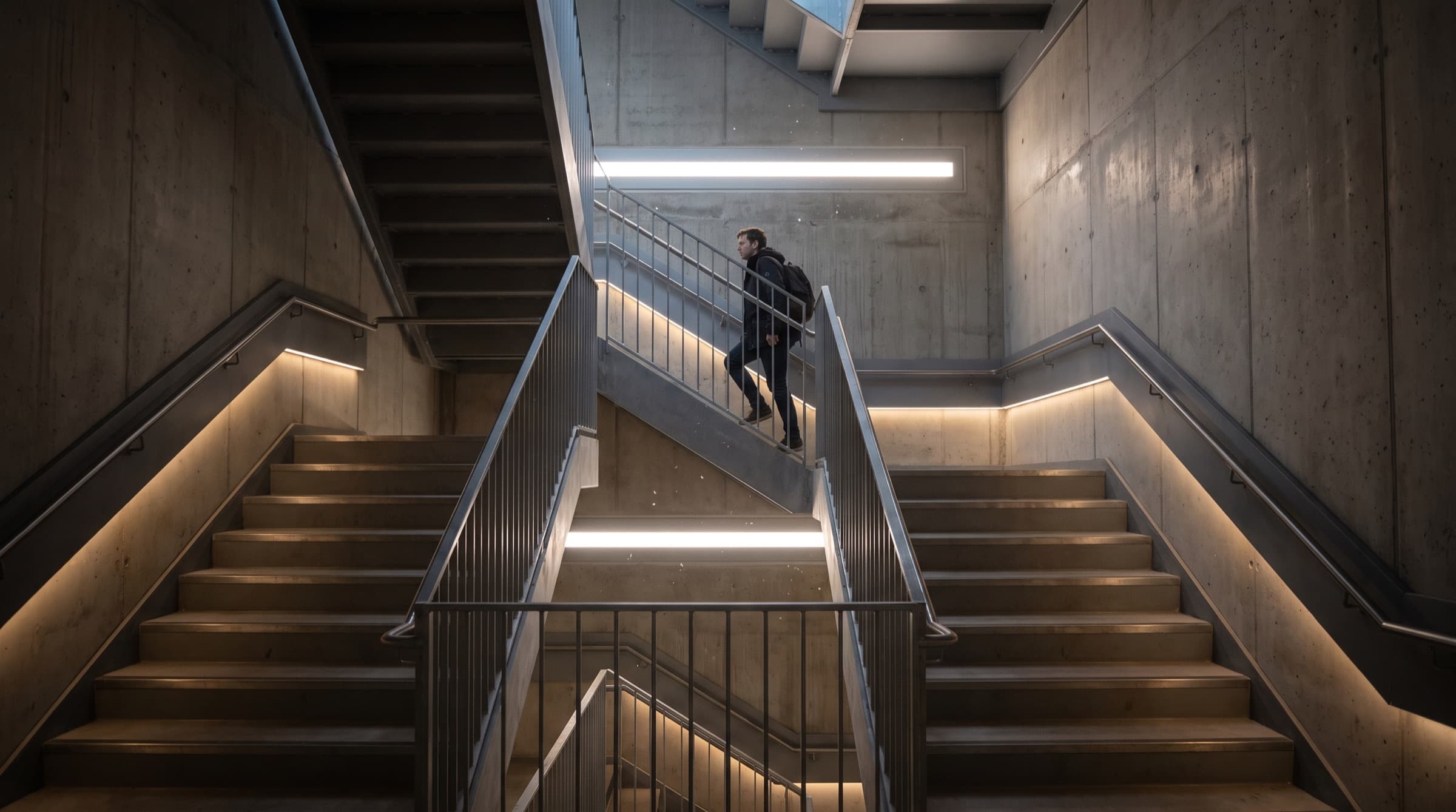
Stairwells are one of the strongest cases. In many countries and jurisdictions, a continuous standby level of lighting in stairwells is required by regulation for security and evacuation — the exact rules vary by country, so confirm the applicable code locally. Modular components let a stairwell hold that required standby level when empty and rise to full the instant someone enters, satisfying the requirement at the lowest possible operating cost. The same logic carries into corridors and escape routes. Try the stairwell 3D showroom.
How a swarm group lights the area ahead of movement along a corridor, dimming behind it — not just the single light overhead.
Who it's for
Got a project that needs smart, presence-aware fixtures?
Tell us about the space and the luminaires you have or plan to use. — we will work through the right mix of antennas, sensors, and drivers with you.
Want to adopt this in your own projects?
If you specify lighting for clients or run an integrator practice, modular MESHLE components let you bring Swarm, tunable white, and daylight harvesting to every project without changing your hardware story. See the integrator path.
Want to integrate MESHLE into your drivers or fixtures?
For luminaire OEMs and driver manufacturers, MESHLE offers pre-certified modules, custom firmware profiles, and white-label app branding so smart control ships as part of your own product. — mention "OEM" in your message and we will route you to the right team.
The hardware you can order today
Every setup on this page runs on standard MESHLE catalog products — CUPOWER SKY antennas and drivers alongside SHARKWARD PIR sensors and MESHLE controllers. Pick the parts that fit your fixture; they share the same UART interface and 20 mm mount, so they work together out of the box.
Frequently asked questions
What is a modular smart-luminaire kit?
It is a small set of interchangeable parts — a Bluetooth antenna, a PIR occupancy sensor, and a driver — that turn almost any luminaire into a smart, presence-aware fixture without custom electronics. The antenna and sensor connect to the driver over a UART cable and mount in the same standard 20 mm hole, so you fit whichever parts each fixture needs. The result joins the MESHLE Bluetooth Mesh and supports Swarm, tunable white, and daylight harvesting.
What is the 20 mm hole and metal mount about?
Both the CUPOWER SKY antenna and the SHARKWARD sensor are designed to drop into a standard 20 mm hole in the fixture's metal surface. Mounting the antenna on the metal skin gives it the radio range a closed metal housing would otherwise block, while the driver stays hidden inside. Because both parts use the same hole and the same UART interface, they are physically and electrically interchangeable.
What is UART and why does it matter here?
UART is a simple serial connection between the driver and the antenna or sensor. It is what makes the radio and the sensor swappable parts rather than fixed components soldered onto a board. Any CUPOWER SKY driver — and the MESHLE 0-10V driver — can take the antenna or the sensor over that same UART cable, which is the heart of the modular idea.
Which drivers work with the antenna and sensor?
The CUPOWER SKY drivers — constant-current drivers with an MCU but no Bluetooth of their own — accept the SKY antenna or the SHARKWARD sensor over UART. MESHLE's own 0-10V driver (4-channel) also accepts both parts over UART, so the same antenna and sensor span CUPOWER drivers and MESHLE's own. The CUPOWER SKY family includes linear and compact form factors and tunable-white options.
Antenna or sensor — which does my fixture need?
It depends on the role the fixture plays. Fit only the antenna if the luminaire should be controllable and join the mesh but rely on neighbours for presence. Fit only the sensor if you want it to contribute occupancy data. Fit both for a fully self-aware node that senses and responds on its own. The choice is made per fixture at install time, not locked into a board design.
Does this need Wi-Fi, the cloud, or a hub?
No. The modular parts run on the MESHLE Bluetooth Mesh, locally between devices. No internet, no Wi-Fi, no cloud, and no central hub is required — MESHLE is offline-first. A MESHLE Gateway can be added later if you want remote access, voice control, or BMS integration, but it is optional and does not change how the lights behave locally.
Can I retrofit an existing luminaire?
Often, yes. If a fixture has — or can take — a 20 mm hole in its metal surface and uses a compatible driver, the antenna and sensor can be added to make it smart. For fixtures that cannot host the parts directly, MESHLE also offers interface controllers that bring existing luminaires onto the mesh. The right approach depends on the specific fixture, which our team can confirm.
How is Swarm different from a basic corridor function?
Corridor function is a per-driver pattern where one luminaire goes to full output and the next one or two follow at a reduced level — one-dimensional and scripted. MESHLE Swarm is area-wide: every luminaire in the group knows the closest active sensor across the whole space and computes its own brightness from that, with no master fixture. Swarm is a strict superset of corridor function. See the swarm lighting guide for the full comparison.
Does it support tunable white and Human Centric Lighting?
Yes, with a tunable-white driver. The same modular parts then deliver warm-to-cool white control and Human Centric Lighting, where colour temperature shifts through the day for circadian comfort. HCL runs on top of Swarm — one layer decides how bright, the other decides what colour temperature. The tunable white (CCT) interface shows how the white-light controls work in the MESHLE App.
How much energy does this save?
Because lights only run at full brightness where presence is detected, and dim or stay off everywhere else, total operating hours drop substantially compared with always-on lighting. The exact saving depends entirely on the space, the occupancy pattern, and the idle level you configure, so we do not publish a single percentage — any honest figure is project-specific. We are happy to model the saving for your layout.
Is the sensor suitable for outdoor use?
Yes. The SHARKWARD Bluetooth Sensor is rated IP66, which suits it to outdoor pole and pathway lighting as well as washdown and industrial environments, not just clean indoor ceilings. The CUPOWER SKY antenna mounting on the metal skin also helps maintain range in outdoor luminaires.
How many fixtures can be on one network?
A single MESHLE Bluetooth Mesh network supports up to 255 nodes. For larger installations, multiple mesh networks can be unified through the MESHLE Edge server, scaling to up to 20,000 devices across unified zones. Very large sites are usually split into logical groups — per floor, per aisle, per zone.
Deep dive: DALI lighting control on Bluetooth Mesh — DALI-2/D4i compatible, up to 8 addresses per node, no rewiring.