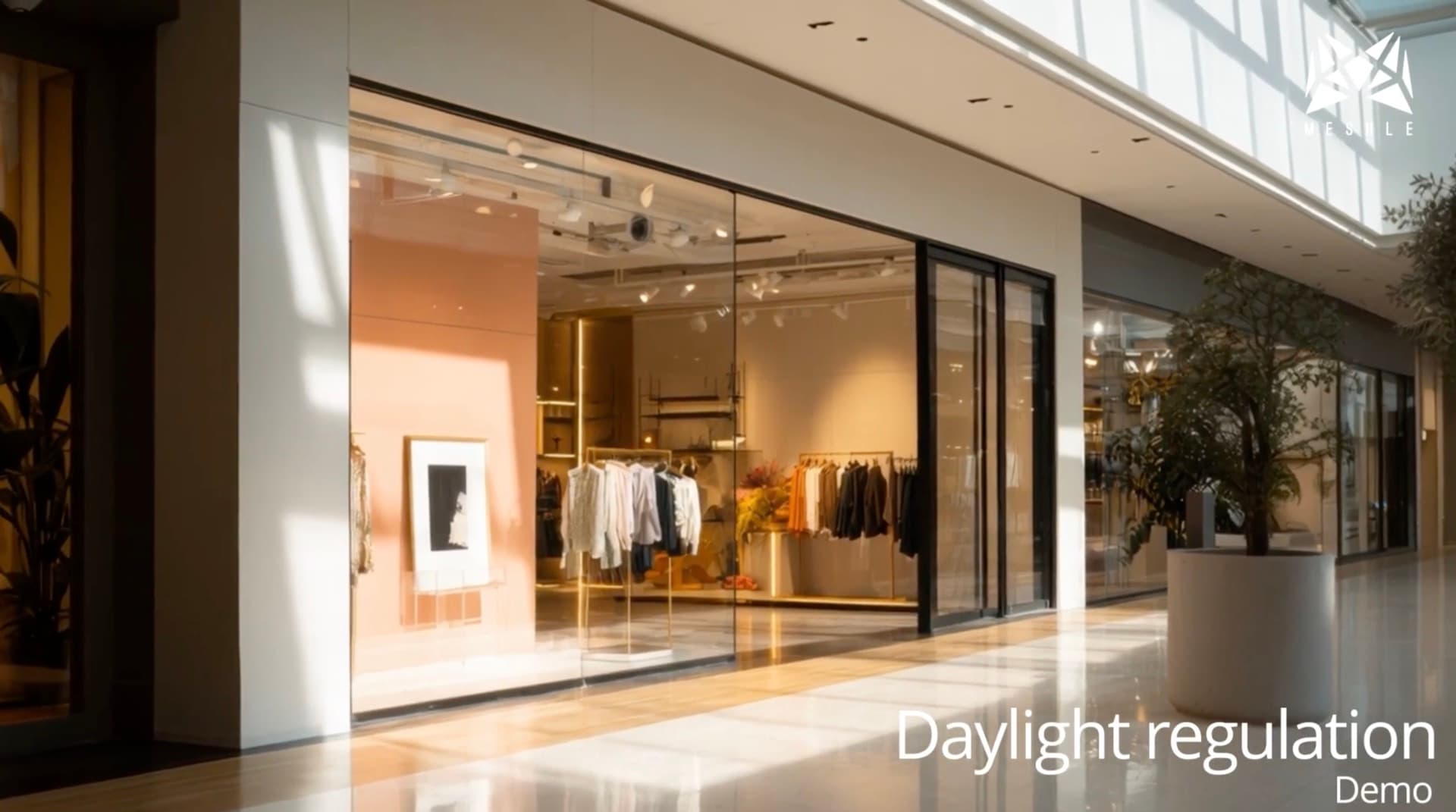
Daylight Harvesting in a Shopping Mall: A MESHLE Storefront Case Study
Daylight harvesting means letting natural light do part of the work. Instead of running artificial lighting at a fixed level all day, a daylight harvesting system measures how much daylight is already in the room and dims the lights to match — so you only spend energy on the light you actually need.
That is exactly what MESHLE set up in a shopping mall in Ingolstadt, Germany. The mall has a glass roof, and on bright days that roof floods the storefront areas with changing natural light. The first two rows of storefront lighting were configured to adjust their brightness automatically to the daylight coming through the glass.
The result: a consistent visual appearance for every storefront, and lower energy use during the brightest hours of the day. This is a short look at how the deployment works — and where daylight harvesting controls make sense beyond this project.
The challenge: strict energy efficiency for daylight-exposed storefronts
The project came with two firm requirements. First, the LED drivers had to run with a defined maximum output limitation — a hard ceiling on how much power each driver could deliver. Second, every area exposed to daylight had to support daylight regulation, so the lighting would respond to changing natural light rather than burn at full output all day.
For a retail environment, both requirements matter. Storefronts need a consistent, polished look from open to close, regardless of whether it is a grey morning or a bright afternoon. At the same time, lighting that ignores available daylight wastes energy and inflates running costs across a building the size of a mall. The challenge was to meet both at once.
How daylight harvesting works in this deployment
The setup follows a simple sensor-to-driver loop. A photocell measures the ambient brightness in the storefront zone — how much daylight is actually coming through the glass roof at any moment. That lux reading is the input for the daylight regulation.
The reading travels across the MESHLE Bluetooth Mesh network to the LED drivers controlling the first two rows of storefront lighting. As daylight rises, the lights dim down; as it fades, they come back up — keeping the perceived brightness of the storefronts steady. Artificial light only tops up what the daylight does not provide.
On top of that, each driver enforces its defined maximum output. The driver's current setting is adjusted via NFC, which caps how much power it can ever deliver. So the system does two things at once: it limits the maximum driver output where required, and it adapts the storefront lighting dynamically to the available daylight. Because it all runs on the local MESHLE Bluetooth Mesh, the regulation happens on the devices themselves — no cloud, no internet connection in the loop.
Daylight harvesting in action: MESHLE storefront lighting dimming to the daylight in an Ingolstadt shopping mall.
Benefits of energy efficient lighting control with daylight harvesting
Pairing daylight harvesting controls with output-limited drivers delivers several wins for a retail building:
- Lower energy use during bright hours — lights dim as daylight rises, so power is spent only on the light that is actually needed.
- Consistent storefront appearance — the daylight sensor keeps perceived brightness steady, so storefronts look the same in any weather.
- Built-in efficiency ceiling — NFC current adjustment enforces the defined maximum driver output the project required.
- Offline-first, no cloud needed — the sensor-to-driver loop runs locally on the MESHLE Bluetooth Mesh, so daylight regulation keeps working with no internet connection.
- Retrofit-friendly and low maintenance — daylight regulation is configured in the MESHLE App; once set, it runs on its own with little ongoing upkeep.
Products used in this project
This deployment came down to two devices working together: a sensor that reads the daylight, and a driver that acts on it. Both join the same MESHLE Bluetooth Mesh and are configured in the MESHLE App.
The ML-HBWDSW Ceiling High Bay PIR Occupancy Detector & Photocell (DANLERS) provides the light reading — its photocell measures ambient brightness, and that lux value drives the daylight regulation. The ID ECSCI 42/230/300-1050 NFC ML W (model 167005) is the LED driver that does the dimming; its current is adjusted via NFC, which is what enforces the defined maximum-output limitation the project required.
Where daylight harvesting fits beyond this project
Anywhere natural light reaches the floor, daylight harvesting can cut waste without changing how the space feels. The same approach used in this Ingolstadt mall fits any building with glass facades or skylights: shopping malls and retail storefronts, atriums and lobbies, and offices with daylight-exposed work areas. Wherever daylight already does part of the job, a daylight sensor and MESHLE-controlled drivers let the artificial lighting do only the rest. The same daylight regulation can be combined with MESHLE Swarm, so presence and daylight together decide how much light an area gets.
Frequently asked questions
What is daylight harvesting?
Daylight harvesting is a lighting control method that measures the natural daylight in a space and automatically dims the artificial lighting to match. You get a consistent brightness level while using less energy, because the lights only add what the daylight does not already provide.
How does daylight harvesting save energy?
A daylight sensor reads how bright the space already is, and the lights dim down as natural light increases. During the brightest hours of the day, the artificial lighting runs at a much lower level — or off — so you spend energy only on the light that is actually needed.
What hardware do you need for daylight harvesting?
You need a daylight (lux) sensor to measure ambient brightness and dimmable drivers or controllers to act on the reading. In the Ingolstadt mall, MESHLE used the ML-HBWDSW photocell and the ID ECSCI 42/230/300-1050 NFC ML W LED driver, both connected over the MESHLE Bluetooth Mesh.
Can daylight harvesting be retrofitted?
Yes. Because MESHLE daylight harvesting controls run on a self-healing Bluetooth Mesh, devices can be added to existing lighting without rewiring a central control system. The daylight regulation is then configured in the MESHLE App.
Does MESHLE daylight harvesting need the internet or cloud?
No. The sensor-to-driver loop runs locally on the MESHLE Bluetooth Mesh, so daylight regulation works fully offline. The cloud is optional and only needed for remote access or building-management integration, not for the daylight harvesting itself.
Next steps
Planning daylight harvesting or energy efficient lighting control for your own building? Browse the MESHLE product catalog to find the drivers, sensors, and controllers that fit your project, or talk to our team about your requirements — from defined output limits to full daylight regulation.