SPI Light Explained: Addressable LED Control and the Standby-Power Problem
What is SPI light?
SPI light is addressable LED lighting — a strip where every LED, or every small group of LEDs, can be controlled individually. Instead of the whole run showing a single color, an SPI light strip can show a different color and brightness at every point along its length, all at the same time. That is what makes flowing gradients, chasing effects, and per-pixel animation possible.
The name comes from the data protocol the strip uses. SPI (Serial Peripheral Interface) is the serial data signal that carries instructions to the chips on the strip. Because each LED listens to that signal, people call the whole category SPI light or, when they mean the strip itself, an SPI LED strip or pixel LED.
Contrast this with a conventional analog strip. On an analog, constant-voltage RGB strip, the entire run is wired as one circuit — change the color and every LED on the strip changes together. There are no individual pixels. SPI light is the opposite: each pixel is its own addressable point, which is exactly why addressable LED strips have become the foundation of dynamic, effect-driven lighting.
How SPI light works
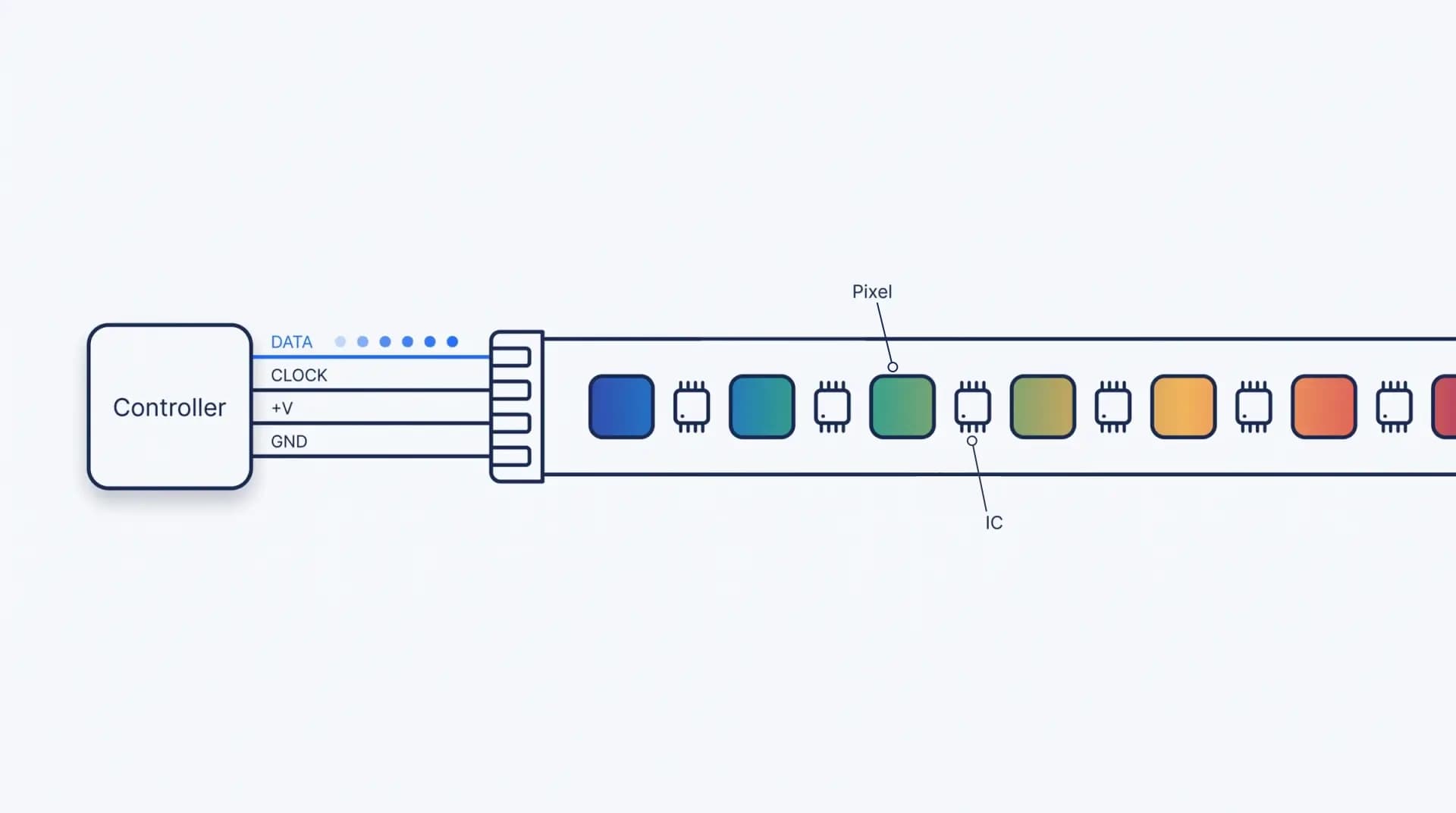
At the heart of every SPI light strip is a chain of small driver ICs. Each IC controls one LED or one cluster of LEDs — that is your "pixel." A data line runs the length of the strip, and an SPI light controller generates and injects a stream of per-pixel instructions onto that line: pixel 1 this color, pixel 2 that brightness, pixel 3 off, and so on, refreshed many times per second.
Each IC reads the data meant for it, lights its LED accordingly, and passes the rest of the signal on to the next IC down the line. Multiply that across hundreds or thousands of pixels and you get smooth, fully independent control over the entire strip.
There are two common wiring styles. Single-wire protocols carry everything on one data line with precise timing — the widely used WS2812B and SK6812 work this way. Clocked protocols add a separate clock line alongside the data line, like APA102 and SK9822, which trades an extra wire for higher, steadier refresh rates. Either way, the job of the SPI light controller is the same: produce the correct signal and feed it to the strip.
MESHLE SPI light demo: per-pixel animations and color running on an addressable LED strip, controlled over MESHLE Bluetooth Mesh.
Addressable LED strip types
Not all addressable LED strip is the same. The common variants:
- Single-color addressable — one color channel per pixel, individually dimmable along the run.
- CCT / tunable-white addressable — per-pixel warm-to-cool white, for dynamic white-light gradients.
- RGB addressable — full color per pixel; WS2812B is the classic example.
- RGBW addressable — RGB plus a dedicated white LED per pixel, e.g. SK6812 RGBW, for cleaner whites.
- RGB+CCT addressable — full color and a true tunable white per pixel, the most capable SPI LED strip type.
Two more numbers decide how an SPI light strip behaves. Pixel density — typically 30, 60, or 144 LEDs per meter — sets how fine your effects can be: more ICs per meter means finer pixel control and smoother gradients. And voltage — commonly 5V, 12V, or 24V — affects run length and voltage drop. Higher IC count gives you more resolution but also more chips drawing power, which matters for the standby-power issue we cover below.
Why SPI light is used in professional lighting
It is easy to assume SPI light is a hobby or consumer toy — strips behind a TV, a gaming desk, a string of party colors. In reality, SPI light is a professional-grade technology, and the reasons specifiers choose it are concrete:
- Better LEDs and tighter color consistency. Professional SPI LED strip uses higher-grade, better-binned LEDs, so color stays consistent pixel-to-pixel and strip-to-strip — essential for architecture and brand-critical work.
- High pixel density. With more ICs per meter, gradients are smooth and effects are fine-grained rather than blocky.
- Longer rated lifespan. Professional-grade strip and drivers are rated to run reliably for years in permanent installations.
- True per-pixel control. Facades, signage, stage and event lighting, and architectural accent work all depend on addressing each point individually — something only addressable LED lighting can deliver.
That professional use is exactly why the next point matters so much. When you run dozens of meters and thousands of ICs in a permanent install, anything those chips do while the light is supposedly "off" gets multiplied across the whole installation — including the standby power most SPI light controllers leave running.
The standby-power problem with SPI light controllers
Here is a problem most buyers never hear about. Most SPI light controllers on the market keep the LED strip energized even when the light is "off." The data signal stops, the pixels go dark — but the strip stays powered, so every IC on it keeps drawing its small quiescent current.
On a short strip that is negligible. Across a long, dense, professional SPI LED strip with thousands of ICs, it is real, continuous wasted power — every hour of every day the installation is "off." Worse, that idle draw typically exceeds the standby-power limits set by efficiency regulations, such as the EU ErP / ecodesign ceiling of roughly 0.5 W standby. For a compliant professional install, that is not a rounding error — it is a problem.
The MESHLE SPI LED controller solves it. When the light is switched off, the MESHLE SPI LED controller cuts power to the strip entirely, eliminating the standby IC draw. "Off" really means off — zero pixel current, no creeping standby waste, and a clean path to meeting standby-power regulations even on large, dense runs.
The MESHLE SPI LED controller
The MESHLE SPI LED controller (model 568P-6) is an SPI light controller built for professional addressable installations. It drives addressable single-color, CCT, RGB, and RGBCCT strip, handles up to 600 ICs, and ships with built-in effects plus a full animation editor for designing your own per-pixel sequences. See the full specs on the MESHLE SPI LED controller product page.
Because it runs on MESHLE Bluetooth Mesh, every MESHLE SPI LED controller joins the same self-healing network as your other MESHLE lights, drivers, and sensors — and it works fully offline. No WiFi, no hub, no cloud required: schedules, scenes, and animations are stored on the device and run locally. You can also pair it with kinetic, battery-free switches and sensors, so a wall switch or a presence sensor can trigger your SPI light scenes without any wiring.
And it closes the standby-power gap described above. The MESHLE SPI LED controller cuts power to the strip when the light is off, so the IC draw that most controllers leave running is simply gone — better efficiency, easier regulatory compliance, and genuine "off" across every meter of your SPI LED strip.
See the MESHLE SPI LED controller
Frequently asked questions
What is SPI light?
What is an SPI light controller?
Do SPI light controllers waste power when off?
What LED strip types work with SPI light?
Why is SPI light used in professional lighting?
Next steps
See full specifications for the MESHLE SPI LED controller, browse the complete MESHLE product catalog, or get in touch with our team to discuss your addressable SPI light project.