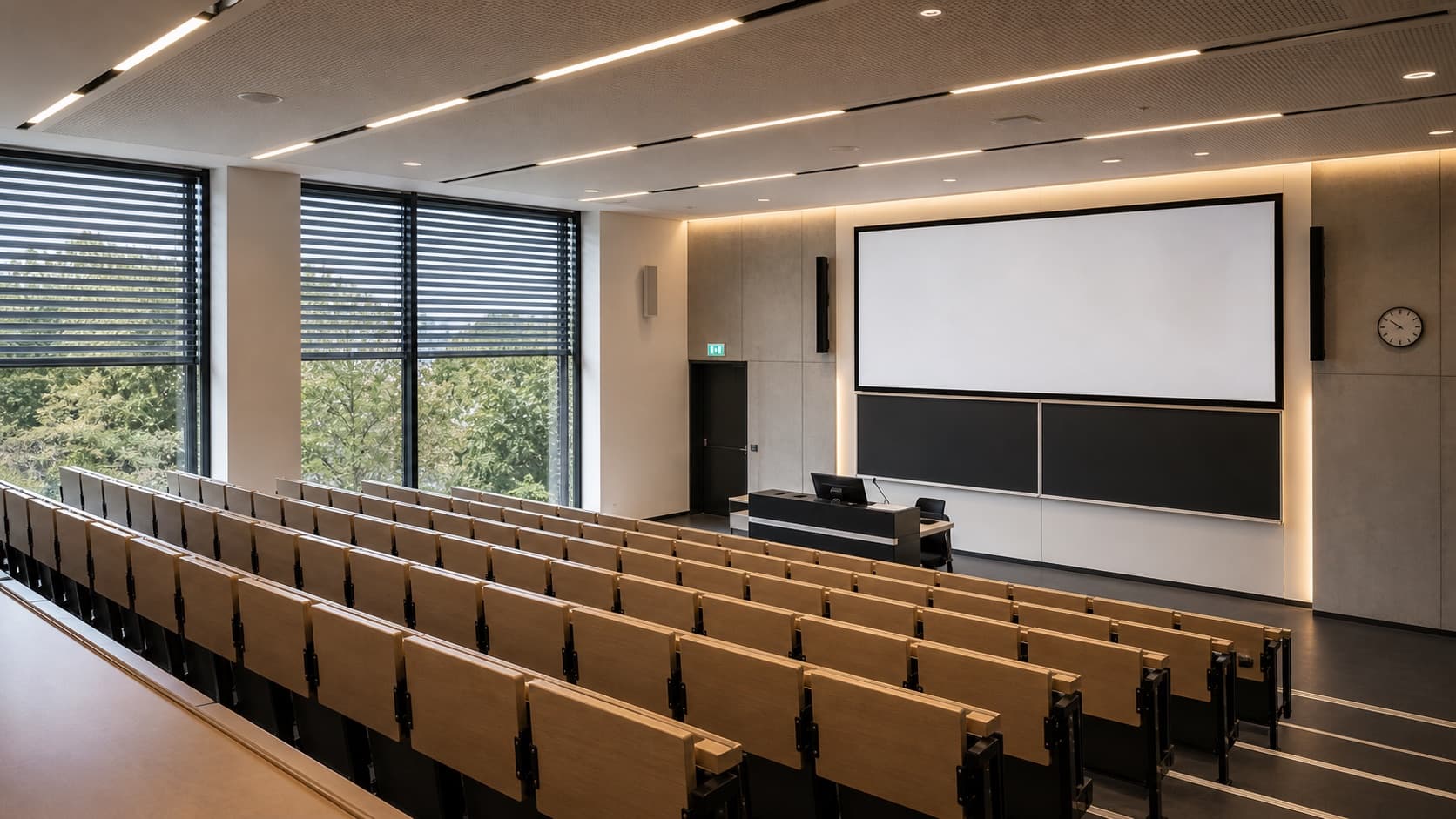
Smart Campus Lighting on MESHLE Bluetooth Mesh
Light that follows the timetable: bright corridors at passing periods, daylight-balanced classrooms, tunable-white lecture halls, and dark sports halls when nobody's there. MESHLE Bluetooth Mesh runs reliably across an entire campus without per-room Wi-Fi or cloud dependencies.
Lighting for Every Campus Space
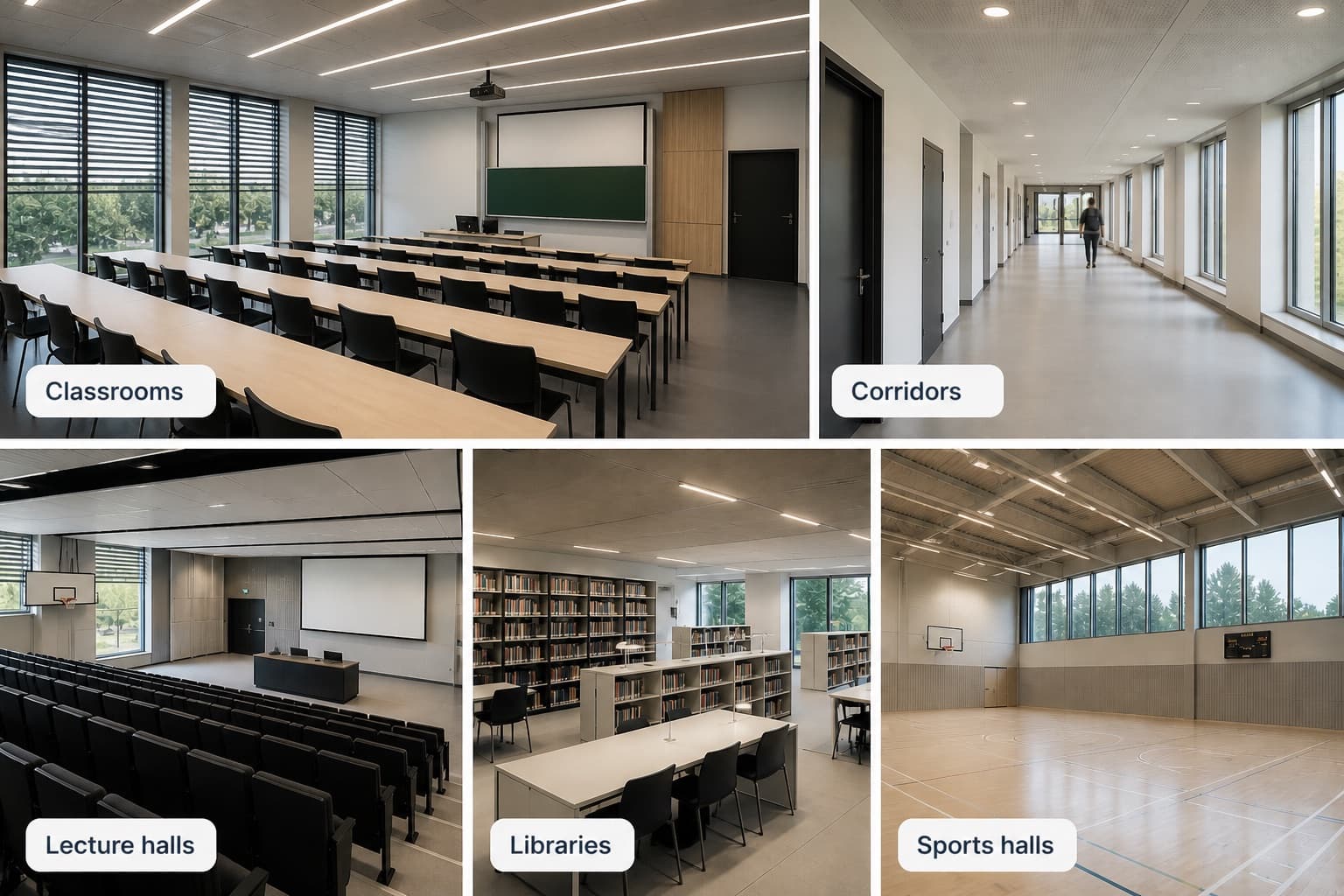
Five space types where MESHLE Bluetooth Mesh changes the operating logic of campus lighting — from passing-period corridor traffic to tunable-white lecture halls and after-hours sports facilities.
- Classrooms
- Lecture Halls
- Libraries
- Corridors
- Sports Halls
Corridors and Sports Halls That Switch Themselves Off
Campus traffic is bimodal — short, intense passing-period peaks separated by long idle stretches when classes are in session. Sports halls and gyms sit empty outside scheduled bookings. Swarm uses presence sensors at the luminaire to drive light where movement actually is, and pull it back everywhere else.
- Passing-period response — Corridors ramp to full output the moment classroom doors open and pull back to a low idle within minutes.
- Sports-hall standby — Halls stay dark outside booked sessions; first detected entrant brings up the appropriate scene.
- Sensor at the luminaire — Detection happens locally — no central controller, no per-room Wi-Fi, no cloud round-trip.
- LBNL benchmark — Cross-sector LBNL meta-analysis reports ~24% average occupancy savings; education sits in line with this band.
Daylight First, Electric Light Only as Needed
Classrooms and libraries usually have generous glazing. Photocell-driven dimming keeps task illuminance on target while electric light recedes whenever the sky delivers. Heschong Mahone's "Daylighting in Schools" research points in a positive direction for student performance; we're conservative about magnitudes, decisive about the principle.
- Per-zone photocell dimming along window-adjacent rows in classrooms and reading areas.
- EN 17037 daylight provision targets and DIN EN 12464-1 educational-premises references inform target setpoints.
- LBNL data points to ~28% daylight harvesting savings (cross-sector, by analogy to education).
- Combined occupancy + daylight stacks to ~38% in LBNL data — the operating-cost case for both.
Tunable White for Classrooms and Lecture Halls
Cooler, brighter light in the morning and after lunch; warmer, calmer light at the day's edges. Tunable-white luminaires on MESHLE Bluetooth Mesh shift along schedule, scene, or manual override. The research direction is consistent — LRC / Figueiro work on alertness, Barkmann et al. on classroom concentration — even where exact magnitudes remain debated.
- Schedule-driven CCT shifts aligned to teaching rhythm: morning ramp-up, post-lunch lift, afternoon wind-down.
- Scene presets per room: lecture, discussion, exam, presentation. Recall in one tap from wall switch or app.
- WELL v2 Feature L03 (Circadian Lighting Design) and IES RP-3 "Educational Facility Lighting" inform our defaults.
- Teacher override always wins — automation is a baseline, not a lock.
Shutters and Slats on the Same Mesh
Partner-manufactured shutter controllers running MESHLE firmware join the same MESHLE Bluetooth Mesh as your luminaires and work with virtually any motor — roller shutters, venetian blinds, awnings, pergolas. A guided calibration wizard captures 25%, 50%, 75% and 100% positions so position and slat angle land precisely every time. For schools and universities, that means lecture-hall blackout, classroom glare control, and library daylight coordination all run from one mesh, with no cloud round-trip.
- Slat angle and spin-down for venetian blinds, with motor travel time, start delay and direction invert tunable per device.
- Coordinates with Daylight Harvesting on the same mesh — slats tilt and electric light dim together to hold target lux.
- Lecture-hall AV scenes, exam-hall blackout, and south-facing classroom glare control run as scheduled scenes with teacher override.
- Copy device settings to a whole window row in one tap; auto-recalibration keeps long runs of skylight or clerestory shutters in sync.
QR Light Control for Speakers and AV Crews
Visiting professors, conference speakers, substitute teachers, and event AV crews need to dim a hall or recall a scene now — not after IT enrols them in the campus identity system. A signed, time-bounded QR code opens a Web App with exactly the controls they need, for exactly the room they're in, for exactly the window they need it.
- No app install, no account creation — Web App opens straight from the QR scan.
- Scoped to one room and one time window: lecture hall A from 14:00 to 16:00, then it expires.
- No campus IDM enrolment for short-window guests — the operations team prints the QR, the speaker uses it.
- Same offline-first MESHLE Bluetooth Mesh underneath; the QR is a permission layer, not a new transport.
Plays Nicely with YourCampus BMS
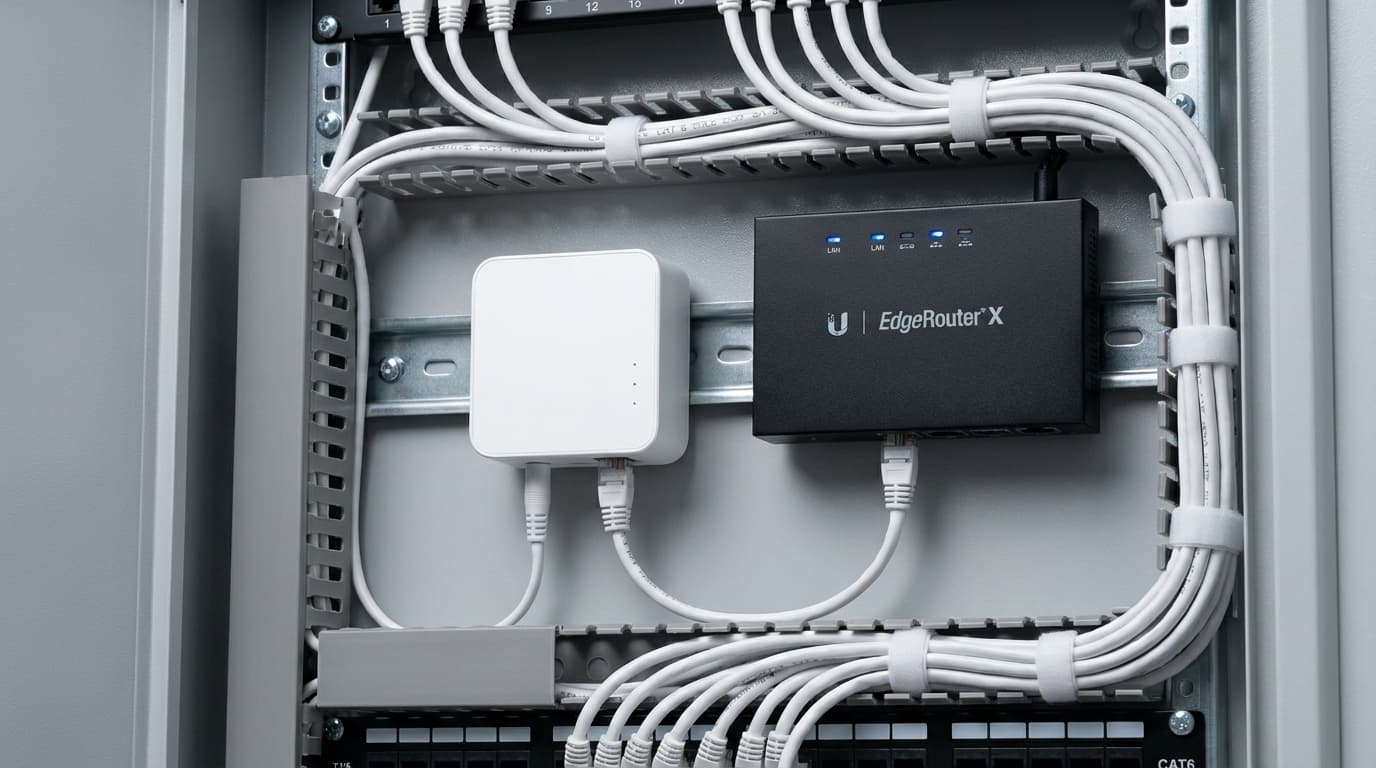
The MESHLE Gateway (M602) bridges MESHLE Bluetooth Mesh to the protocols campus operations and capital-projects teams already specify — without locking the lighting layer to any one of them. Matter-ready.
REST API
Pull room status and push scene recalls from campus dashboards, room-booking systems, or AV controllers.
MQTT
Stream telemetry to facility analytics — occupancy, energy, scene usage — across the whole campus.
Modbus TCP/IP
Talk to building controls, electrical metering, and HVAC the way most campus BMS already speak.
BACnet
Edge tier adds BACnet for full BMS interop alongside the Gateway protocols.
Plan Your Campus Lighting on MESHLE
Whether you're refitting a single classroom block or specifying lighting controls for a new academic building, MESHLE Bluetooth Mesh scales from one room to a full campus on offline-first infrastructure.
Read more
Deep-dive into the technology, integration paths, and field notes behind MESHLE.
Swarm — presence-aware lighting
Light reacts to occupancy across corridors, stairwells, warehouses, and parking decks — no central controller required.
Read moreBlogSwarm lighting — the MESHLE guide
The authoritative MESHLE reference. What swarm lighting actually is, how it works in the app, and where it fits — with a live simulator.
Read moreTechnologyBluetooth Mesh Gateway
Bridge MESHLE Mesh to BACnet, Modbus, MQTT, REST API, and Matter for BMS integration.
Read moreIntegrationManufacturer integration paths
Module, flash, OEM — three ways to integrate MESHLE Bluetooth Mesh into luminaires and lighting systems.
Read moreBlogCasambi alternatives — 7 platforms compared
Side-by-side B2B comparison of seven wireless lighting control platforms that offer an alternative to Casambi.
Read moreBlogOffline-first smart lighting
Buildings last decades, cloud subscriptions don't: why lighting control should keep working without one.
Read more