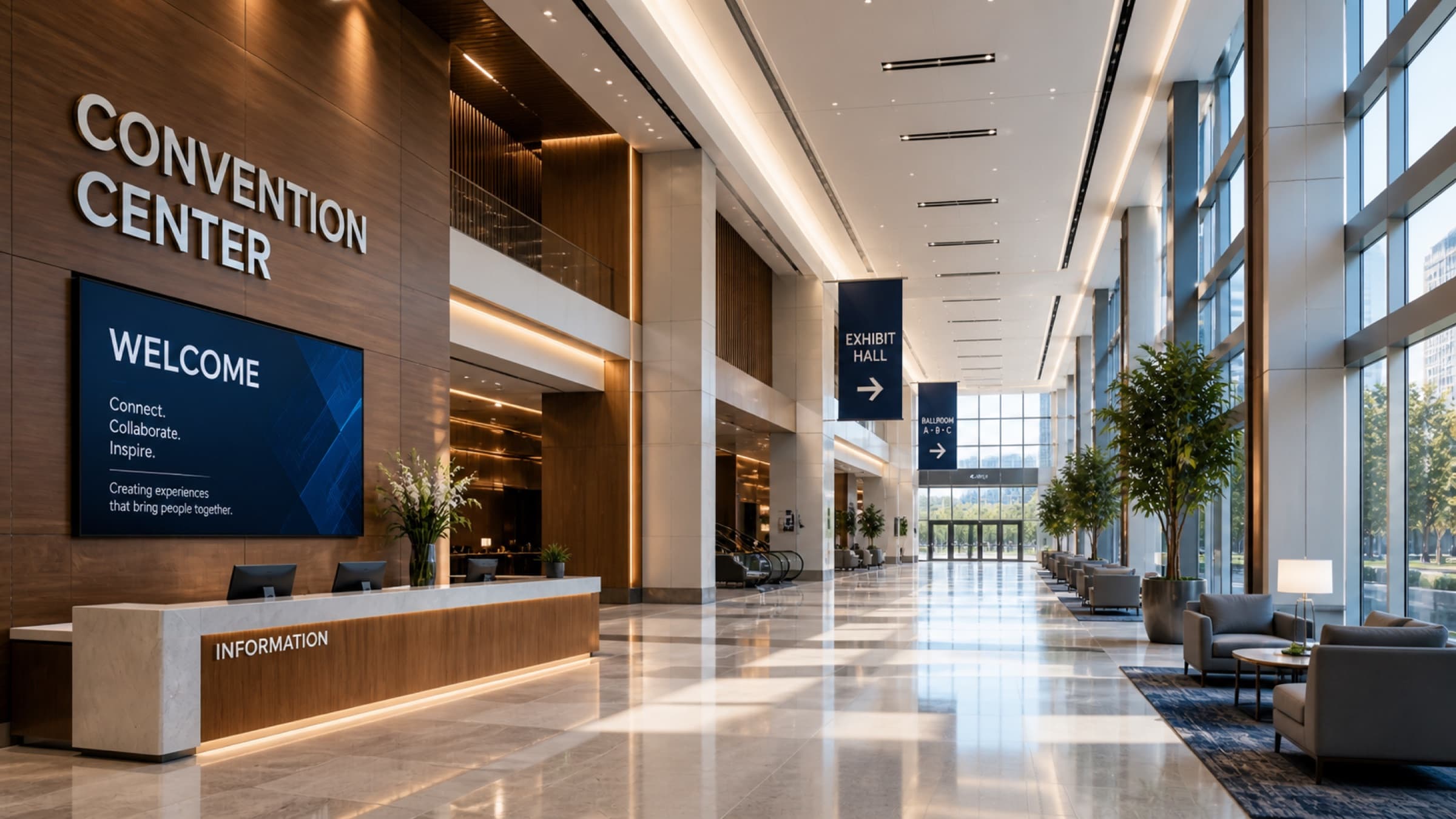
Smart Conference Center Lighting on MESHLE Bluetooth Mesh
Auditoriums that blackout cleanly for projection, breakout rooms with one-tap presentation scenes, foyers that wave-load during breaks, exhibition halls that follow setup crews, and catering floors that warm for evening receptions. MESHLE Bluetooth Mesh runs the venue on offline-first infrastructure — no per-room Wi-Fi, no cloud round-trip, no scenes failing mid-keynote when the uplink stutters.
Lighting for Every Conference Zone
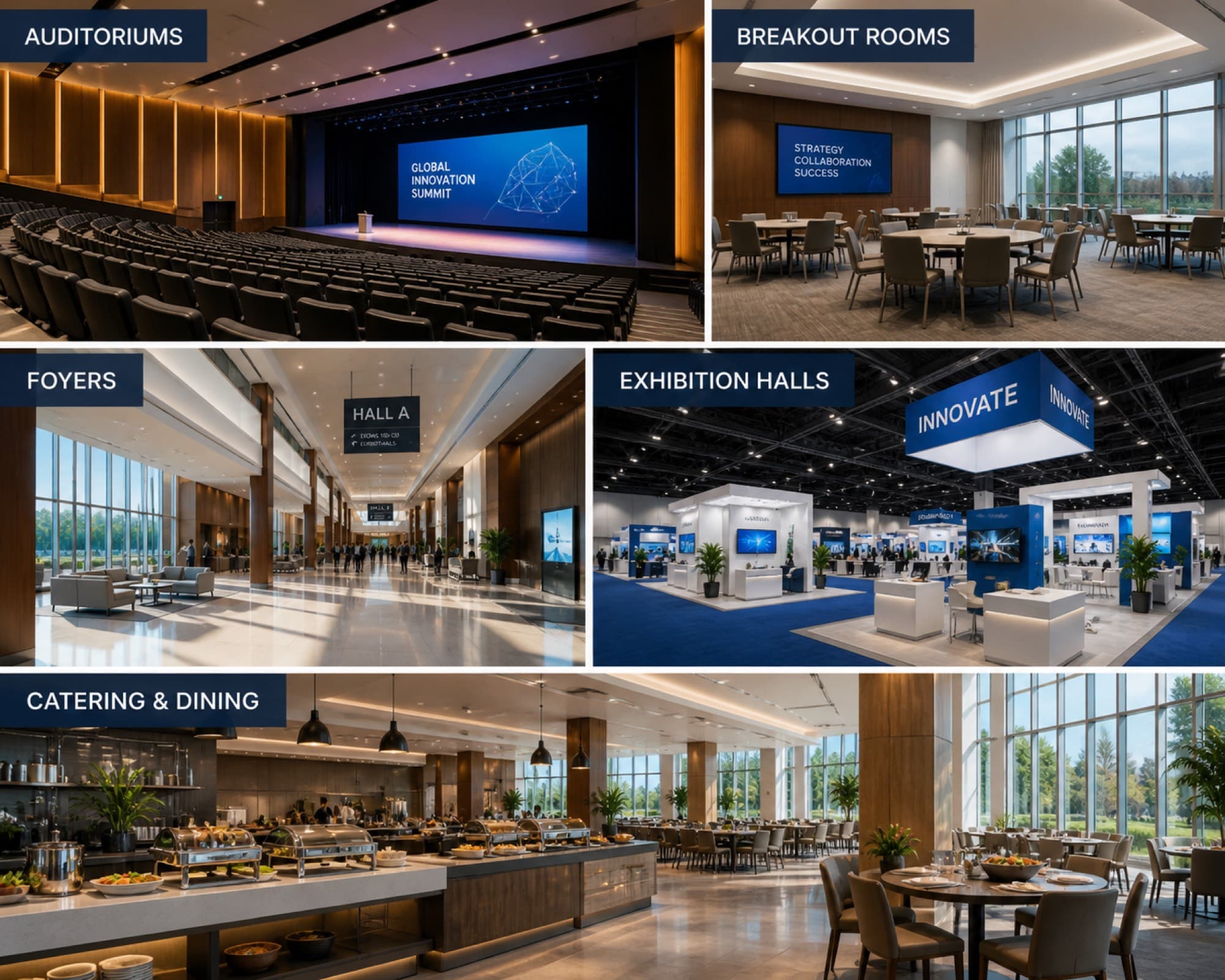
Five space types where MESHLE Bluetooth Mesh changes the operating logic of a conference venue — from auditorium projection cycles and breakout-room workshops to foyer break-load, exhibition-hall setup, and catering floors that flex from buffet to evening reception.
- Auditoriums
- Breakout Rooms
- Foyers
- Exhibition Halls
- Catering & Dining
Halls That Light Up Around Each Session
Conference occupancy swings between idle and packed inside a single day — auditoriums sit empty between sessions while foyers wave-load on breaks. Swarm uses presence sensors at the luminaire to drive light where movement actually is and pull it back everywhere else, so static schedules don't keep half-empty halls fully lit between programs.
- Session-room granularity — Auditoriums and breakout rooms hold at low idle between programs and lift cluster by cluster as delegates filter in.
- Foyer break-load — Foyers and corridors brighten as crowds flow out on the break and recede again once doors close on the next session.
- Sensor at the luminaire — Detection happens locally — no central controller, no per-room Wi-Fi, no cloud round-trip when 800 delegates spill into the foyer.
- LBNL benchmark — LBNL's cross-sector meta-analysis reports around 24% average occupancy savings; office-derived, applied by analogy to session rooms and back-of-house corridors with similar variable-occupancy profiles. Field studies typically come in below simulation projections — read the figure as a directional ceiling, not a guarantee.
Daylight Harvesting in Glazed Foyers
Modern conference architecture leans on glazed circulation — atria, south-facing foyers, clerestoried exhibition halls. Closed-loop daylight dimming subtracts daylight from electric output per fixture instead of running flat-rate, holding target task levels while electric light recedes whenever the sky delivers.
- Per-zone photocell dimming on glazed foyers, atria, and perimeter exhibition-hall bays.
- EN 17037 daylight provision and DIN EN 12464-1 indoor task-illuminance frame inform target setpoints across registration, crew areas, and back-of-house.
- LBNL data points to roughly 28% daylight harvesting savings (office-derived, applied by analogy to glazed conference foyers and atria).
- Combined occupancy + daylight stacks to around 38% in LBNL data — the operating-cost case for venues running both layers.
Tunable White for Multi-Day Programs
Multi-day conferences mean long indoor sessions and post-lunch dips. Tunable-white luminaires on MESHLE Bluetooth Mesh shift along schedule, scene, or manual override, so morning plenaries open cool and bright while evening receptions land warmer. The Brown et al. (2022, PLOS Biology) consensus calls for at least 250 melanopic EDI lux at the eye during the day to support alertness; CIE S 026 defines the metrology behind any credible HCL claim.
- Schedule-driven CCT shifts across the program day: morning plenary, midday session block, afternoon panel, evening reception.
- Scene presets per session room — House Lights, Presentation, Panel, Workshop, Q&A — recalled in one tap from wall switch, app, or AV desk.
- WELL v2 Feature L03 (Circadian Lighting Design) operationalises melanopic EDI targets in delegate seating areas during program hours.
- DIN EN 12464-1 sets the visual baseline for indoor task lighting; HCL melanopic targets are tuned above that floor.
Blackout and Glare on the Same Mesh
Auditorium projection needs clean blackout; south-glass foyers need afternoon glare control; exhibition-hall clerestories want slat-angle redirection during setup. Partner-manufactured shutter controllers running MESHLE firmware join the same MESHLE Bluetooth Mesh as your luminaires and work with virtually any motor — roller shutters, venetian blinds, blackout drapes, awnings. A guided calibration wizard captures 25%, 50%, 75% and 100% positions. EN 17037 frames the assessment via Daylight Glare Probability; CIE 117 and the UGR method underpin discomfort-glare metrics.
- Auditorium blackout recall as part of the Presentation scene — drapes close and house light dims on one tap.
- South-foyer glare control coordinates with daylight harvesting on the same mesh — slats tilt and electric light dim together to hold target lux without afternoon glare.
- Slat angle and spin-down for venetian blinds, with motor travel time, start delay and direction invert tunable per device.
- EN 17037 specifies that glare should not be exceeded for more than 5% of occupied time — applies to south-facing foyer glazing and exhibition-hall clerestories.
QR Light Control for AV Crews and Speakers
Touring AV crews, freelance riggers, and visiting keynote speakers need scoped temporary control during their event window — they don't get venue staff accounts, and the show-caller can't wait for IT to provision a login at 09:55. A signed, time-bounded QR code opens a Web App with exactly the controls they need, for exactly the room they're running, for exactly the window they're booked.
- No app install, no account creation — the Web App opens straight from the QR scan.
- Scoped to one room and one event window: gaffer adjusts auditorium cues during the keynote, then access expires.
- Touring crew dims the breakout room for a workshop without venue staff routing every change through the booth.
- Visiting speakers recall a House Lights or Presentation scene from the lectern, inside operator-set min/max bounds — the EN 12464-1 task-area frame holds.
Plays Nicely with YourBuilding Stack
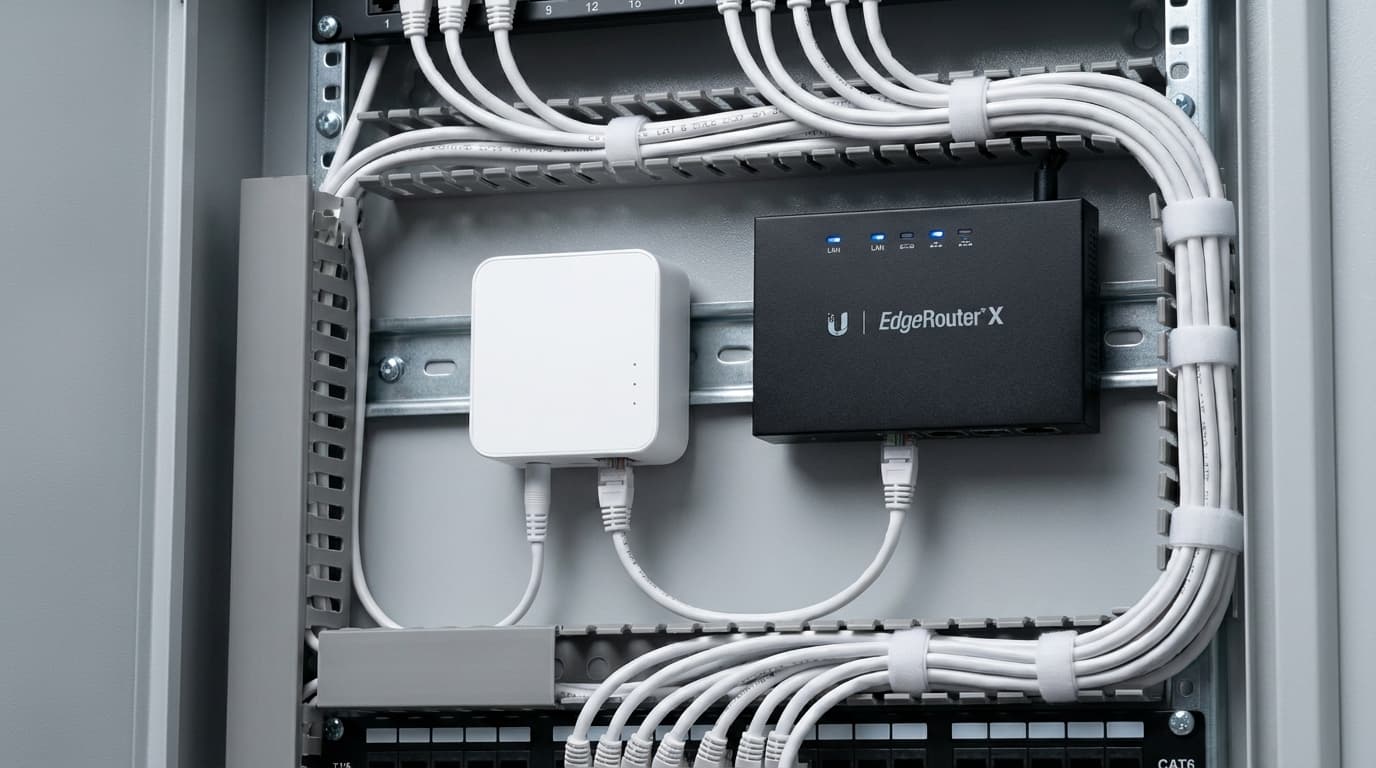
The MESHLE Gateway (M602) bridges MESHLE Bluetooth Mesh to the protocols venue operations and capital-projects teams already specify — without locking the lighting layer to any one of them. Matter-ready.
REST API
Pull room status and push scene recalls from booking platforms, AV control desks, or front-of-house dashboards.
MQTT
Stream telemetry to facility analytics — occupancy by zone, energy, scene usage — across every hall and floor.
Modbus TCP/IP
Talk to building controls, electrical sub-metering, and HVAC the way most BMS already speak.
BACnet
Edge tier adds BACnet for full BMS interop alongside the Gateway protocols.
Plan Your Conference Lighting on MESHLE
Whether you're refitting a single auditorium or specifying lighting controls for a multi-hall conference and exhibition complex, MESHLE Bluetooth Mesh scales from one breakout room to a full venue on offline-first infrastructure.
Read more
Deep-dive into the technology, integration paths, and field notes behind MESHLE.
Swarm — presence-aware lighting
Light reacts to occupancy across corridors, stairwells, warehouses, and parking decks — no central controller required.
Read moreBlogSwarm lighting — the MESHLE guide
The authoritative MESHLE reference. What swarm lighting actually is, how it works in the app, and where it fits — with a live simulator.
Read moreTechnologyBluetooth Mesh Gateway
Bridge MESHLE Mesh to BACnet, Modbus, MQTT, REST API, and Matter for BMS integration.
Read moreIntegrationManufacturer integration paths
Module, flash, OEM — three ways to integrate MESHLE Bluetooth Mesh into luminaires and lighting systems.
Read moreBlogCasambi alternatives — 7 platforms compared
Side-by-side B2B comparison of seven wireless lighting control platforms that offer an alternative to Casambi.
Read moreBlogOffline-first smart lighting
Buildings last decades, cloud subscriptions don't: why lighting control should keep working without one.
Read more