What Is Human Centric Lighting? A Complete Guide
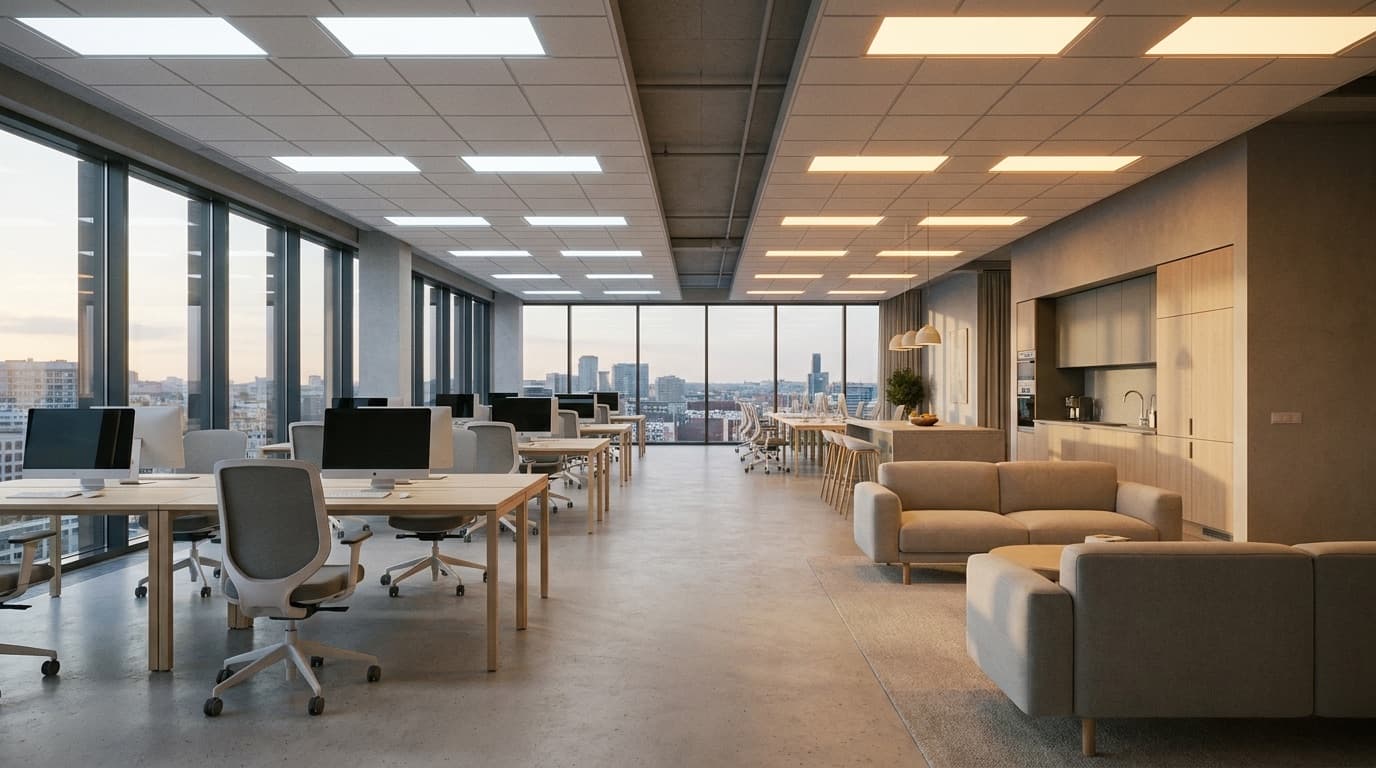
Human centric lighting (HCL) is electric light that changes its colour temperature and brightness across the day to work with your body clock instead of against it: cool and bright in the morning, warm and dim at night, echoing the arc of natural daylight. If you've ever felt wired at 11 p.m. under bright white office light, or foggy at 9 a.m. in a dim room, you've felt the problem HCL is built to solve. This guide covers what human centric lighting is, the benefits it delivers, the biology behind it, how it's measured and certified, and the part most articles skip: how to actually implement it.
I've spent 15 years commissioning lighting controls. The science is solid, the hardware is finally cheap enough, and most "circadian" products still under-deliver because they change one lever when they should change two. MESHLE builds wireless tunable-white controls and LED drivers that deliver HCL, and where that's relevant I'll say so plainly rather than dressing it up.
What is human centric lighting (HCL)?
Human centric lighting is lighting that automatically adjusts its colour temperature and intensity throughout the day to support human circadian rhythm, alertness and wellbeing.
Daylight isn't constant. It's cool and intense at midday (a clear noon sky can read well past 6,500 K and thousands of lux) and warm and dim at dawn and dusk. For all of human history that changing light was the signal our bodies used to keep time. Indoor electric light broke that signal: it's usually the same colour and brightness from 8 a.m. to midnight. HCL puts the signal back by making indoor light move the way daylight does.
You'll see the same idea under different names. Circadian lighting emphasises the body-clock angle. The International Commission on Illumination (CIE), the body that sets lighting metrics, prefers integrative lighting, light that integrates visual, emotional and biological effects. They describe the same practice. Throughout this guide I'll use "human centric lighting" and "HCL".
One clarification up front, because it trips people up: HCL is not the same thing as tunable white. Tunable white is a hardware capability, a luminaire with a warm channel and a cool channel that you can blend. HCL is what you do with that capability: run a schedule that moves the blend across the day. Tunable white is the instrument; HCL is the tune. You need the instrument to play, which is why we come back to it in the implementation section.
The benefits of human centric lighting
Better sleep and circadian alignment
The clearest benefit is better sleep, and it comes from getting evening light right. Bright, cool light late in the day tells your brain it's still daytime and suppresses melatonin, the hormone that makes you sleepy. Warm, dim light in the evening lets melatonin rise on schedule, so you fall asleep more easily and your sleep timing stabilises. The evening end of an HCL curve matters as much as the morning end, arguably more, because most people already get some bright light during the day but bombard themselves with cool light at night.
Alertness, focus and productivity
The daytime payoff is alertness. Cool, blue-enriched light in the morning and early afternoon raises alertness and can sharpen focus, through the same melatonin-suppressing pathway working in the useful direction. This is the effect offices, schools and control rooms are chasing. It's real, but it's also the claim most oversold (see the honesty note below). HCL doesn't make you smarter; it reduces the drag of being under the wrong light at the wrong time.
Mood and wellbeing
Light and mood are linked. The extreme case is seasonal affective disorder, where a lack of bright winter light drives low mood and bright-light therapy helps. HCL borrows the mild version of that effect: adequate bright, cool light during the day supports better mood and daytime wellbeing, particularly for people in spaces with little or no daylight. It's not a treatment, but for a windowless back office it's a meaningful upgrade over flat, static light.
"Do circadian lights actually work?" — the honest note
This is the question a good specifier should ask, so here's the straight answer.
The biology is not in doubt. Light sets the human body clock; that's textbook physiology, covered in the next section. What's genuinely debated is the size of the effect from a lighting product in a real room that already has some daylight.
The evidence is strongest where daylight is scarce or the body clock is under stress: night-shift workers, hospital and dementia-care settings, submarines, windowless spaces, care homes. There, well-designed HCL shows measurable benefits to sleep, mood and rest-activity rhythms. The evidence is weaker for the "boost office productivity 20%" style of claim in an ordinary, well-daylit space, partly because a window already delivers a strong circadian signal that swamps what a ceiling luminaire adds.
So the trustworthy position: HCL is a proven tool applied to the right problem, and marketing dressing when it's sprayed at spaces that don't need it. Judge a system by whether it meaningfully changes both spectrum and intensity across the day. A luminaire that only warms its colour at night, without dimming, is doing half the job. That "change both levers" test is worth more than any circadian badge on the box.
How human centric lighting works (the science)
If you understand the mechanism, you can tell a real HCL system from a marketing sticker, so it's worth the detail.
Your circadian rhythm and the body clock
Your body runs on a roughly 24-hour internal clock, the circadian rhythm. It's governed by a cluster of neurons in the brain called the suprachiasmatic nucleus (SCN), the master clock. The SCN orchestrates the daily rise and fall of hormones: cortisol peaks in the morning to help you wake and get going, and melatonin rises in the evening to bring on sleep.
This internal clock isn't exactly 24 hours, so it needs a daily reset to stay aligned with the outside world. The single strongest reset signal is light. Get bright light in the morning and your clock locks to the day; get bright light at night and your clock drifts, melatonin is suppressed, and sleep suffers. HCL is, at heart, a way to feed the clock the right light-timing signal indoors.
ipRGCs and melanopsin — the "third photoreceptor"
This is the mechanism that makes all of this specific rather than vague. Your retina has the two photoreceptors everyone learns in school, rods (dim-light vision) and cones (colour vision). It also has a third type, discovered around 2002: intrinsically photosensitive retinal ganglion cells (ipRGCs). These cells contain a pigment called melanopsin, and their job isn't to form images. It's to sense overall light level for the body clock and route that signal straight to the SCN.
The key fact for lighting design: melanopsin is most sensitive to blue-enriched light in roughly the 460–490 nm band. That's why cool, blueish light (higher colour temperature) is circadian-active and warm, amber light is much less so. It also explains why "brightness as your eye perceives it" is the wrong metric for HCL: the ipRGC/melanopsin system responds to a specific slice of the spectrum, not to how bright a light looks. Two lamps can look equally bright to you and have very different circadian effects. That gap is exactly what the melanopic metrics in the next section were invented to close.
Colour temperature (CCT) explained
Correlated colour temperature (CCT) describes whether white light looks warm or cool, and it's measured in kelvin (K). The scale is counter-intuitive at first: lower numbers are warmer (more amber), higher numbers are cooler (more blue-white).
| CCT | Appearance | Everyday reference |
|---|---|---|
| ~2,700 K | Warm white | Incandescent bulb, cosy evening light |
| ~3,000 K | Soft warm white | Hospitality, living rooms |
| ~4,000 K | Neutral white | Offices, kitchens, retail |
| ~5,000 K | Cool white | Task areas, workshops |
| ~6,500 K | Daylight white | Overcast noon sky |
For HCL the important point is that CCT correlates with circadian effect: warmer light (~2,700 K) has less blue content and is gentler on melatonin, while cooler light (toward 6,500 K) is more blue-enriched and more alerting. A tunable-white luminaire lets you move along this scale, which is the raw material HCL works with.
The two levers: spectrum/CCT and intensity
A real HCL system pulls two levers together across the day.
- Lever one, spectrum (CCT): cool in the morning to stimulate the ipRGCs and promote alertness, warm in the evening to protect melatonin.
- Lever two, intensity: brighter during the day (a stronger circadian signal), dimmer in the evening (a weaker one).
The two reinforce each other. Bright cool light in the morning is a strong "it's day" signal; dim warm light at night is a clear "it's night" signal. This paired movement is the daylight curve, and it's what you're actually building when you set up HCL. A system that only changes colour, or only changes brightness, is running on one lever and delivering a fraction of the effect.
How HCL is measured and certified
This is where imprecise marketing gets exposed, so here's the vendor-neutral version. None of the metrics below are MESHLE metrics; they're the shared industry language for quantifying circadian light.
Melanopic lux, EML and melanopic EDI (CIE S 026)
Ordinary lux measures light the way your visual system sees it, weighted to the cones' sensitivity. That's useless for circadian work, because the ipRGC/melanopsin system has a different spectral sensitivity. So the field created light units weighted to melanopsin instead.
The current standard is CIE S 026, which defines melanopic EDI (melanopic Equivalent Daylight Illuminance), expressed in lux. It answers: how circadian-effective is this light, compared with a reference daylight? You'll also still see the older term EML (Equivalent Melanopic Lux) in WELL documentation. Same idea, slightly different reference; melanopic EDI is the newer, harmonised metric. The practical upshot: two installations at the same ordinary lux can have very different melanopic EDI, and it's the melanopic figure that predicts circadian effect.
Circadian stimulus (CS)
Circadian stimulus (CS) is a competing model from the Lighting Research Center. Instead of a lux-style unit, it produces a single number from 0 to about 0.7 that estimates how strongly a given light, at a given intensity, suppresses melatonin. Designers using the CS framework typically target a minimum CS during the day to drive circadian entrainment. It's a different route to the same destination as melanopic EDI: put a number on circadian effect so you can design to it rather than guess.
Standards and guidelines
Three reference points come up repeatedly:
| Standard / guideline | Origin | What it covers |
|---|---|---|
| WELL Building Standard | IWBI (US) | Building-certification credits for circadian lighting design, using melanopic light targets |
| DIN SPEC 67600 | DIN (Germany) | Planning guidance for biologically effective (HCL) lighting |
| UL 24480 | UL (US) | Design guideline for lighting that promotes healthy sleep-wake cycles |
These define how to measure and design circadian light, not a pass/fail "circadian certified" stamp on a product. Be sceptical of any luminaire or controller marketed as "circadian certified"; that's not how the current standards work. What a good product can honestly claim is that it lets you build to these guidelines.
Human centric lighting by setting
Where HCL earns its keep, and why, changes with the room. Broadly, the benefit is largest wherever people spend long hours with little daylight.
| Setting | Primary benefit | Why it matters here |
|---|---|---|
| Healthcare & hospitals | Patient rest, staff alertness | Windowless wards and 24/7 shifts wreck circadian timing; HCL restores a day/night cue |
| Offices & workplaces | Daytime alertness, evening wind-down | Deep-plan floors get little daylight; cool mornings help focus, warm evenings ease overtime |
| Schools & classrooms | Attention and calm | Cooler light supports focus in lessons; warmer, dimmer settings calm younger pupils |
| Hospitality & retail | Atmosphere plus wellbeing | Warm tones set mood; tunable white lets one space shift from bright retail to warm dining |
| The home | Sleep and daily rhythm | Warm, dim evening light protects melatonin; bright mornings help you wake |
Healthcare and hospitals
This is HCL's strongest case. Patients in windowless rooms and staff on rotating shifts are the textbook victims of a broken circadian signal, and studies in these settings show HCL improving sleep, orientation and, in dementia care, reducing evening agitation. If you can only justify HCL in one part of a building, this is usually it.
Offices and workplaces
The mainstream commercial case. Cool, bright light in the morning and early afternoon supports alertness on deep-plan floors that daylight can't reach; a warmer, dimmer late-afternoon setting takes the edge off for people working past sunset. Keep expectations honest: near a bright window the added benefit is modest, so target the interior zones first.
Schools and classrooms
Cooler, brighter light during focused lessons; warmer, dimmer settings for reading corners or younger pupils. Several school programmes use tunable white as a classroom-management tool as much as a circadian one: a "focus" scene and a "calm" scene the teacher can call up.
Hospitality and retail
Here the driver is atmosphere first, wellbeing second, and tunable white pays for itself on flexibility alone: a restaurant runs warm and intimate in the evening, a shop runs crisp and bright by day, sometimes in the same convertible space. Layer an HCL schedule on top and staff working long shifts get a circadian benefit for free.
The home
At home the highest-value move is the simplest: warm, dim light in the evening so you actually get sleepy, and brighter, cooler light in the morning to help you wake. A schedule that shifts the living areas warm after sunset, running automatically, does more for most households' sleep than any single gadget.
How to implement human centric lighting
This is the part the top-ranking guides gloss over, and it's where the money is spent. HCL is two components: the right luminaires and a control layer that drives the curve. This is also where MESHLE fits, so I'll be specific and flag where it's us.
What a system needs — tunable-white luminaires plus a control layer
Every HCL install reduces to two requirements:
- Tunable-white luminaires — fittings with two white channels, warm and cool, that can be blended to any CCT in between. Single-colour fittings can't do HCL; there's no cool channel to bring up. This is non-negotiable hardware.
- A control layer — something that decides the CCT and brightness at any moment and drives the luminaires accordingly, on a schedule. This is where a controls platform like MESHLE lives.
Get both and you have HCL. Miss either and you don't. Everything below is detail on the second requirement, because the first is just a purchasing decision.
Tunable-white LED drivers and CCT control (2-channel warm/cool)
Under the hood, a tunable-white fitting is driven by two output channels: one feeding the warm LEDs, one feeding the cool LEDs. Change the ratio and you change the CCT; change the total and you change the brightness. The CCT / tunable-white interface is how MESHLE handles this: a true 2-channel warm-plus-cool profile that supports HCL natively, with automatic warm-to-cool adjustment across the day over a 2,700–6,500 K range.
Two details worth knowing. First, MESHLE's 2-channel CCT can control direct and indirect light independently: the upper (indirect, ceiling-bounced) and lower (direct, downward) components each get their own white balance and brightness, which matters for free-standing office luminaires. Second, if you want a single fitting to do full-colour work and HCL, the flex PRO 3 RGBTW controller carries a real 2-channel tunable white alongside RGB, so HCL is native rather than faked by mixing white out of red-green-blue.
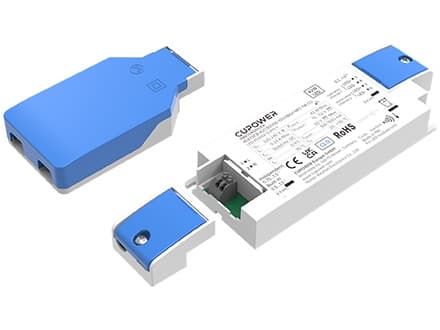
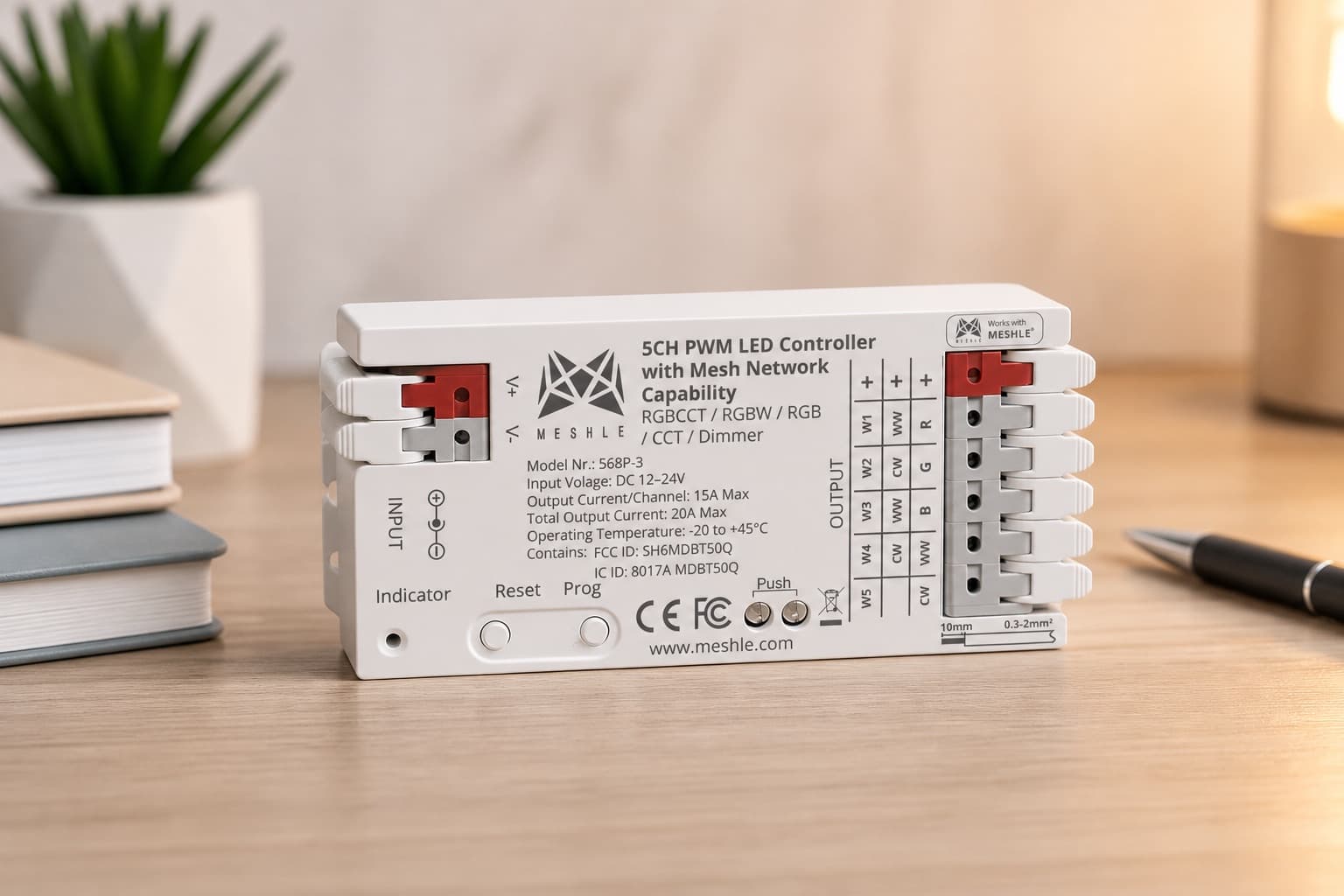
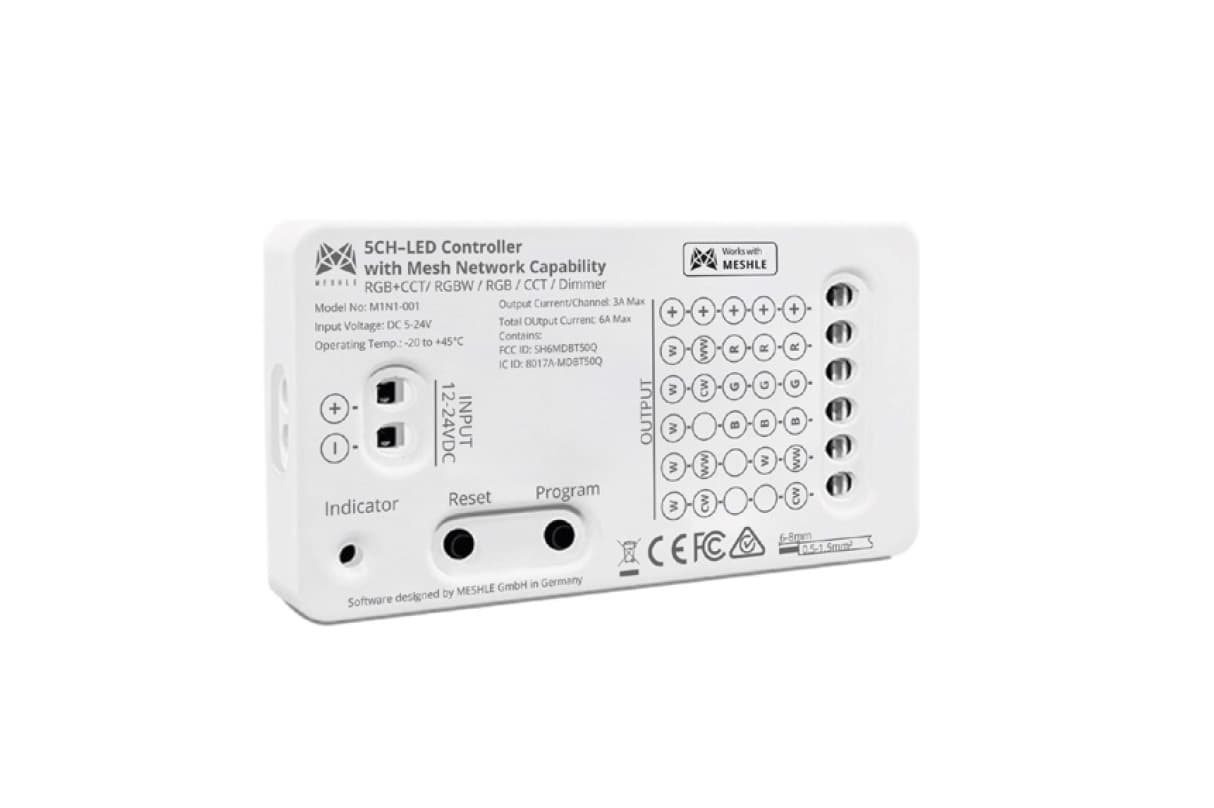
For built-in fittings, the Human-Centric Lighting Driver is a constant-current tunable-white LED driver with MESHLE Bluetooth Mesh and NFC programming built in. One caveat I'll state plainly because it trips OEMs up: it's a constant-current engine for tunable-white downlights, panels, troffers and pendants, not for LED strip or tape, which is a constant-voltage load and needs a different controller. For smaller retrofits — a compact downlight, a strip fitting behind a diffuser, a tunable-white cove — the flex MINI is a 5-channel PWM controller that drives warm-plus-cool white on the same mesh and runs the same HCL schedule from the app.
Automating the day: scheduling, daylight and occupancy sensors, scenes
A curve is only HCL if it runs by itself. Nobody adjusts colour temperature by hand at 3 p.m. So the control layer needs scheduling, and the quality of that scheduling is where systems diverge.
MESHLE's App ships circadian/HCL presets, and the schedules that drive them run locally on the mesh nodes: up to 8 per day, per weekday, on either a fixed time or an astro trigger (sunrise/sunset) with a configurable offset. The astro trigger is the useful one for HCL. Tie the warm-down to actual sunset and the curve tracks the real day across the seasons instead of a fixed clock time. And because the schedule lives on the nodes, the daily curve keeps running with no phone and no cloud in the loop. That offline-first behaviour is a genuine MESHLE differentiator: your circadian schedule shouldn't stop because the Wi-Fi did.
Two automation layers stack neatly on top of the curve:
- Presence — MESHLE Swarm is presence-aware lighting: it decides how bright a light should be based on where people actually are, brightening ahead of movement and dimming behind. Swarm and HCL coexist on one mesh, splitting the job cleanly: Swarm decides how bright, HCL decides what colour temperature. You get occupancy-driven brightness and a circadian colour curve from the same nodes.
- Daylight harvesting — a combined presence-plus-lux sensor on the mesh feeds ambient light readings back to the drivers, dimming them when daylight is already doing the work while HCL keeps shifting the CCT. That pairs energy saving with circadian light on the same hardware. We go deeper on that in the energy-saving lighting controls guide, and there's a real deployment in the daylight harvesting retail case study.
Retrofitting existing fixtures — wired vs wireless
The retrofit question is really: how do you get a control signal to every luminaire without tearing the building apart?
Wired control, typically DALI, is robust and is the incumbent in serious commercial projects, but it means pulling a two-wire control bus to every fitting. In an existing building that's often the whole cost. Wireless control avoids the control wiring entirely: the signal rides the radio, so you only need mains at each fitting. That's why wireless Bluetooth Mesh is the pragmatic retrofit path. MESHLE dims via PWM, phase, DALI and 0–10V drivers and is DALI-2 and D4i compatible, so it can drive existing tunable-white fittings over the interface they already speak, or replace the driver outright.
The hard limit on any retrofit is the luminaire itself: if the fitting is single-colour, no controller, wired or wireless, can produce HCL, because there's no cool channel to raise. In that case the LED module has to change. When you do need building-management integration on top, the MESHLE Gateway (Matter-ready) bridges the mesh to a BMS over REST, MQTT, Modbus TCP/IP and BACnet™.
Practical CCT and intensity across a workday
I won't hand you exact melanopic setpoints. Those depend on your room, your metric (melanopic EDI or CS) and your standard, and inventing precise numbers would be dishonest. But the shape of a good daylight curve is well agreed, so here's the shape:
- Early morning: ramp up brightness and push cool. This is the strong "it's day" signal that helps people wake and entrain the clock.
- Midday: hold the coolest, brightest setting. This is the alertness plateau.
- Afternoon: begin easing colour temperature warmer and intensity down, gently.
- Evening / after sunset: warm and dim clearly. This is the melatonin-protecting phase, and it's the half most static installs get wrong.
Tie the warm-down to the astro/sunset trigger rather than a fixed clock time, so the curve moves with the seasons. Two guardrails from experience: don't leave the space cool and bright late into the evening, and don't drop midday levels so low that daytime loses its circadian punch. Set the shape once, let it run locally, and adjust seasonally if at all.
BACnet™ is a trademark of ASHRAE.
Related MESHLE products
The hardware behind everything above — the pieces you'd actually spec into a project like this.
Frequently asked questions
What is human centric lighting?
Human centric lighting (HCL) is electric lighting that changes its colour temperature and brightness over the course of the day to support human health, alertness and sleep: cool, bright light in the morning and warm, dim light in the evening, echoing the natural arc of daylight. The CIE calls the same idea “integrative lighting”; you'll also see it called circadian lighting.
What are the benefits of human centric lighting?
The benefits reported in research are better sleep and circadian alignment, improved daytime alertness and focus, and better mood, because the right light at the right time tells your body clock whether it's day or night. The effect is largest for people who get little daylight (shift workers, hospital patients, windowless offices) and smaller for someone already sitting by a bright window.
Do circadian lights really work?
The underlying biology is well established: light, especially blue-enriched light, sets your body clock through a photoreceptor called the ipRGC. What's less certain is how much a product delivers in a real, already-daylit room. Evidence is strong in controlled and light-starved settings and weaker in ordinary bright spaces, so judge a claim by whether it changes both spectrum and intensity meaningfully, not by the “circadian” label alone.
How does human centric lighting work?
It works on two levers. Spectrum: cool, blue-enriched light (higher Kelvin) stimulates the ipRGC photoreceptor and suppresses melatonin to promote alertness; warm light (lower Kelvin) does the opposite. Intensity: brighter by day, dimmer by evening. A control layer moves both across the day so indoor light tracks the daylight curve.
What is the difference between human centric lighting and tunable white?
Tunable white is the hardware capability: a luminaire with separate warm and cool LED channels that can be blended to any colour temperature. Human centric lighting is what you do with it, a schedule that automatically moves that colour temperature and brightness through the day to support the body clock. Tunable white is the instrument; HCL is the tune.
What colour temperature is best for human centric lighting?
There's no single best number, because HCL is about change, not a fixed value. A typical curve runs cooler (toward 5,000–6,500 K) and brighter through the middle of the day and warmer (toward 2,700–3,000 K) and dimmer in the evening. What matters is that the light shifts across the day, not that it sits at one “correct” Kelvin.
Can I add human centric lighting to my existing lights, or retrofit it?
Yes, if the luminaires themselves are tunable white (a warm and a cool channel). If they are, you only need to add the control layer, and a wireless system like MESHLE Bluetooth Mesh avoids pulling new control wiring back to a central controller. If your existing fittings are single-colour, the LED module has to be replaced with a tunable-white one. No controller can invent a cool channel that isn't there.
What standards apply to human centric lighting?
The measurement basis is CIE S 026, which defines melanopic EDI (the “how circadian-effective is this light” metric). The circadian stimulus (CS) model is another way to quantify the effect. On the design and building side, the WELL Building Standard sets circadian-lighting credits, Germany's DIN SPEC 67600 gives HCL planning guidance, and UL 24480 offers a design guideline for promoting healthy sleep-wake cycles.