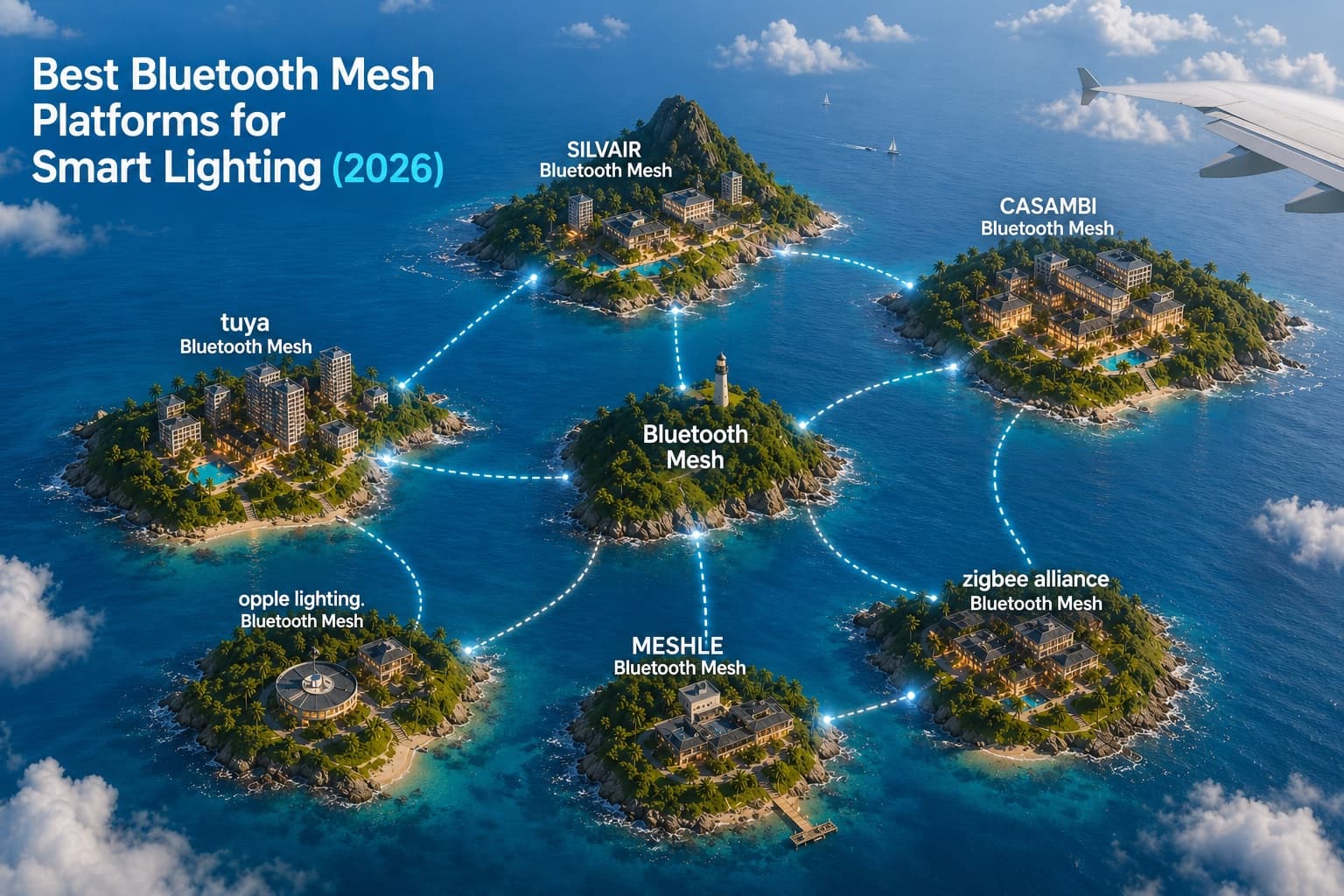
Best Bluetooth Mesh Platforms for Smart Lighting (2026)
Bluetooth Mesh is becoming the go-to technology for smart lighting control. It runs locally, scales to hundreds of devices, and works without cloud infrastructure. But “mesh” has become an umbrella term — not every platform that uses it actually runs on Bluetooth Mesh.
Some use entirely different radio protocols. Others use Bluetooth NLC (Networked Lighting Control), which is part of the Bluetooth ecosystem but takes a different approach than a full proprietary Bluetooth Mesh implementation.
This guide classifies the major platforms by the protocol they actually use and shows which approach fits which project requirements.
What makes a platform “Bluetooth Mesh”?
A Bluetooth Mesh platform runs on Bluetooth 5 hardware, uses a mesh topology where every node can relay messages, and can operate locally without a cloud server. Devices communicate directly with each other.
This is different from:
- Bluetooth NLC (Networked Lighting Control) — standardized profiles built on top of Bluetooth Mesh, defined by the Bluetooth SIG. Benefit: cross-vendor interoperability. Trade-off: the standard covers a defined set of device profiles (lighting control, sensors, energy and, since 2025, HVAC integration); features outside those profiles are vendor-specific. Example: Silvair.
- Proprietary Bluetooth Mesh — custom implementations built on Bluetooth hardware but with proprietary firmware and features beyond the SIG standard. Benefit: deeper feature sets. Trade-off: you depend on one platform vendor’s firmware, even when the hardware comes from many brands. Examples: MESHLE, Casambi.
- Non-Bluetooth protocols — mesh systems whose network does not run on Bluetooth. Examples: Wirepas (used by INGY), myMesh (proprietary RF mesh by Chess; Bluetooth only via a separate commissioning gateway).
Bluetooth Mesh platforms: proprietary and standard-based
All platforms in this section run on Bluetooth, but not in the same way. Some vendors built their own proprietary mesh protocol on Bluetooth hardware and control the firmware, protocol behavior and feature set themselves. Others build on the Bluetooth SIG Mesh standard or describe their system as open. The general trade-off of a proprietary protocol is a closer tie to that vendor’s platform.
Proprietary mesh on Bluetooth hardware
MESHLE (Germany) — Proprietary Bluetooth Mesh protocol, developed since 2013. Offline-first architecture: all automations run locally on-device. Offers Swarm Intelligence, a Scene & Animation Editor, and 3-tier scalability (mesh → gateway → edge). Beyond lighting, MESHLE also controls shutters, blinds, and smart home devices.
Casambi (Finland) — One of the largest installed bases: more than 250,000 projects and 6 million nodes, according to Casambi. Hardware is available from more than 300 brands. Easy commissioning and intuitive app. A strong choice for projects where compatibility with many fixture manufacturers matters most.
Lumos Controls (USA) — Proprietary BLE mesh platform with cloud or on-premise analytics. US-based, deployed in 30+ countries.
MeshTek Labs (USA) — Proprietary BLE mesh with edge computing. Focused on outdoor lighting, smart city, and horticulture applications.
Xicato (USA) — Proprietary “Xmesh” built on BLE. Used in museums, hospitality, retail, healthcare and offices, with well-documented museum projects such as the Van Gogh Museum.
SIG-standard, open or BLE-based platforms
BubblyNet (USA) — Bluetooth Mesh qualified software and SIG-qualified devices with circadian lighting support. Mainly US references in commercial buildings and hospitality.
Cognian (Australia) — BLE-based SYNCROMESH platform for smart building lighting control and IoT. Also offers occupancy counting and building data analytics. Mainly Australian projects.
LEDVANCE LINK (US and Canada) — Networked lighting control based on Bluetooth Mesh, with Bluetooth Mesh-listed devices; no gateway required. Sold by LEDVANCE LLC; the parent company, spun off from OSRAM, is headquartered in Garching, Germany.
Vossloh-Schwabe Blu2Light (Germany) — Open Bluetooth Mesh system for professional lighting OEMs. Supports DALI and DMX alongside Bluetooth. Also offers Casambi-compatible variants.
Bluetooth NLC
Silvair (Poland) is a major contributor to the Bluetooth Mesh and NLC standards at the SIG level. NLC provides standardized device profiles: dimming, occupancy sensing, ambient light sensing and, since July 2025, HVAC integration. The key benefit: qualified devices from different manufacturers can work together in the same installation. The standard defines a fixed set of device profiles; features beyond them (e.g. animations, shutter control) depend on each vendor.
Companies that have built products on Silvair’s technology include:
- Danlers (UK) — occupancy and light level sensors
- DG Light (Italy) — presented a Silvair-based Bluetooth Mesh DALI converter in 2018
- Fulham (USA) — LED drivers and fixture controllers with Bluetooth Mesh
- LSI Industries (USA) — outdoor lighting (AirLink Blue)
- TruBlu / mwConnect — commercial lighting control platform
For projects where cross-vendor interoperability is the top priority, the NLC approach is worth considering. For projects that need features beyond the NLC profiles, check what each platform actually ships.
Looking for a Silvair alternative? When proprietary Bluetooth Mesh fits better
Silvair is a legitimate choice — and for projects where cross-vendor interoperability is the single most important requirement, the NLC route is hard to beat. Bluetooth NLC is built for cross-vendor interoperability: qualified devices from Silvair ecosystem partners such as Danlers, Fulham, LSI Industries and mwConnect TruBlu are designed to work together in one installation, and that genuinely matters for spec-driven commercial work.
The trade-off is feature scope. The Bluetooth NLC standard defines a focused set of profiles — dimming, occupancy, ambient light, scenes, energy monitoring and, since 2025, HVAC integration. The standard itself does not define animations or radius-based presence following; vendors add such features on top (Silvair, for example, offers zone linking between adjacent zones). Proprietary Bluetooth Mesh platforms build more of this into their own stack. Casambi documents animation scenes, multi-network “Sites” and visitor access levels. MESHLE offers synchronised animation, multi-tenant guest access and unified multi-network dashboards, plus swarm-based presence propagation across zones.
If you are migrating an existing Silvair specification or evaluating proprietary alternatives, we will be publishing a dedicated Silvair alternatives migration guide soon. Until then, the Casambi alternatives comparison covers the same decision from a different angle.
Non-Bluetooth Mesh
These platforms use mesh networking but not the Bluetooth Mesh protocol. That is not necessarily a disadvantage — each protocol has its own strengths.
INGY (Netherlands) — Uses the Wirepas protocol. Fully offline-capable, with primarily one-off license fees. Strong in large-scale commercial buildings, broader smart building applications and open integrations.
myMesh / Chess (Netherlands) — Proprietary, radio-agnostic mesh protocol (2.4 GHz and 868/915 MHz variants). Developed since 2003. Strength: very large networks with 10,000+ devices.
Signify Interact Pro — Luminaires communicate over Zigbee. Bluetooth links the phone app to the system (commissioning and, in networks without a gateway, local control), not luminaire to luminaire. Strength: broad luminaire portfolio from Signify/Philips.
How to choose the right platform
There is no universally best platform. The right choice depends on your project requirements:
- Cross-vendor compatibility — If you need to mix devices from different manufacturers, NLC-based platforms (Silvair ecosystem) offer the clearest path.
- Broad fixture selection — If maximum choice of compatible luminaires matters, Casambi hardware is available from more than 300 brands.
- Advanced automation — If you need presence-following light or synchronised effects, check what each platform actually ships. MESHLE, for example, offers swarm intelligence and a synced animation editor.
- Offline operation — If the system must work reliably without internet, look for platforms with full offline-first architecture.
- Scale — For very large installations (10,000+ devices), platforms like myMesh or systems with gateway/edge architecture provide suitable solutions.
- Cost model — If total cost matters, compare upfront and recurring charges. INGY primarily uses one-off license fees, with no mandatory cloud subscription for lighting control.
Frequently asked questions
What is the difference between Bluetooth NLC and Bluetooth Mesh?
NLC (Networked Lighting Control) is a set of standardized profiles built on top of Bluetooth Mesh, defined by the Bluetooth SIG. It guarantees interoperability between certified devices from different manufacturers but covers a narrower set of lighting-specific functions. Proprietary Bluetooth Mesh platforms typically offer a broader feature set but may not interoperate with other vendors’ devices.
Can Bluetooth Mesh lighting work without internet?
Yes. Bluetooth Mesh operates locally between devices without requiring cloud or internet connectivity. However, the degree of offline capability varies by platform — some run all automations on-device, while others rely on cloud for certain features like remote access or analytics.
Standards-based or proprietary — which is better?
Neither is universally better. Standards-based platforms (NLC) offer interoperability and reduced vendor lock-in, making them a good fit for projects that require mixing devices from different manufacturers. Proprietary platforms tend to offer deeper feature sets and tighter integration, which can be advantageous for projects that need advanced automation or a unified ecosystem.
Conclusion
The Bluetooth Mesh landscape for smart lighting is diverse. Standards-based approaches like NLC offer interoperability, proprietary platforms offer deeper features, and some proven systems deliberately use other protocols for specific advantages. The key step is to clearly define your project requirements — the right choice follows from there.